May every encounter lessen suffering for people, places and all beings.
Thoughts of a Catholic
“All you have to do is take care of your posture and breathing with a kind, considerate, and thoughtful spirit.”
― Dainin Katagiri, Each Moment Is the Universe: Zen and the Way of Being Time
There is nothing like having a Priest pull up your profile and then post it saying you aren’t Catholic because you love Zen to get one thinking about books to read or reread and all the reasons I love Zen. I think Richard Rohr captures it best.
Reading List
McDaniel, Richard. Catholicism and Zen, 2013
Macinnes, Elaine. Zen Contemplation for Christians, 2003.
Macinnes, Elaine. The Flowing Bridge: Guidance on Beginning Zen Koans, 2007.
Kennedy, Robert. Zen Spirit, Christian Sprit: The Place of Zen in Christian Life, 1995.
Chetwynd, Tom. Zen and the Kingdom of Heaven. Boston: Wisdom Publications, 2001.
Eusden, John Dykstra. Zen and Christian: The Journey Between. New York: Crossroad, 1981.
Graham, Dom Aelred. Zen Catholicism. New York: Crossroad, 1999.
Hackett, David G. The Silent Dialogue. New York: Continuum, 1996.
Hart, Brother Patrick (ed). Thomas Merton/Monk: A Monastic Tribute. Kalamazoo, MI: Cistercian Publications, 1983.
Inchausti, Robert. Thomas Merton’s American Prophecy. Albany: State University of New York Press, 1988.
Lipski, Alexander. Thomas Merton and Asia: His Quest for Utopia. Kalamazoo: Cistercian Publications, 1983.
Kadowaki, JK, SJ. Zen and the Bible: A Priest’s Experience. London: Routledge and Kegan Paul, 1982.
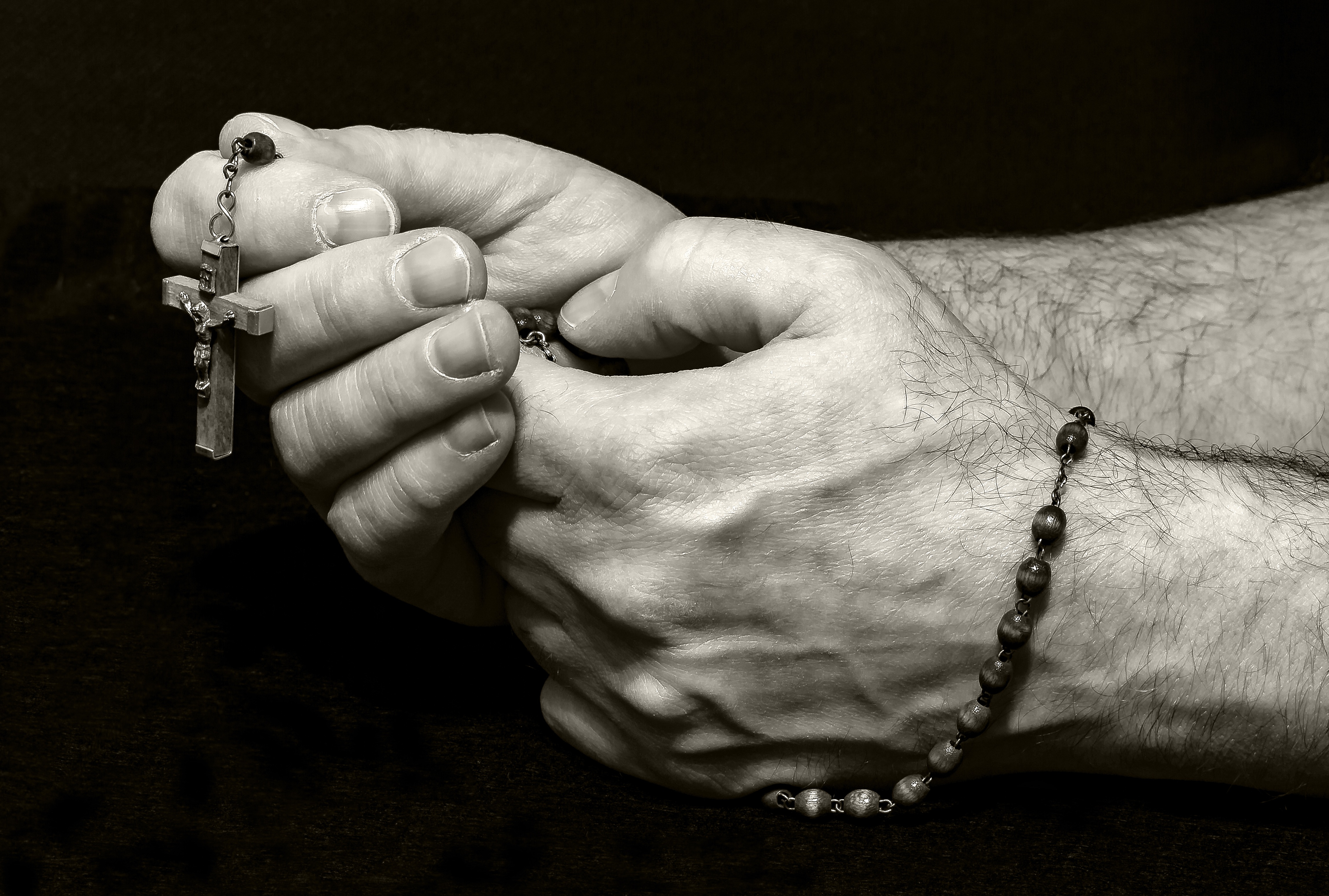
Tonight when I watch the RNC I will be holding two things: a) a glass of wine, and 2) the Rosary of Modern Sorrows. I have a large collection of rosaries that have been given to me by my husband, Priests, friends, and some I picked up because I wanted to support the people that made them. Why I want a glass of wine should be obvious, but the Rosary of Modern Sorrows is different. I like it because it represents what I think are the issues we need to address to make America a better and more equitable community.
I will pray this rosary for all people that have turned a blind eye to caging children, denying access to refugees, or discrimination against those who are LGBTQ. I pray for those that don’t understand Black Lives Matter, believe people chose poverty, and refuse to see the harm that is being done to our environment.
Rosary of Modern Sorrows
We pray for the lives of women and their children, born and unborn, and the unjust societal structures that steal hope, healthcare, and economic security from these, our most vulnerable mothers.
We pray for mother earth, our fragile environment, the animals, land, and oceans entrusted to our stewardship and care.
We pray for immigrants, refugees, Dreamers, and all who seek a life free from violence and the threat of death and abuse. May we imagine ourselves in their place, knowing we would do anything to secure safety for ourselves and our families.
We pray for those discriminated against because of the color of their skin. We pray for those who are caught in the school-to-prison pipeline, trapped by corporations that gain financially from incarceration. We pray for our innate biases, that we may recognize these and then choose to move beyond them. We pray for awareness of the attitudes and structures that remain from our history of slavery.
We pray for a welcoming of LGBTQ people by all churches, temples, mosques, and synagogues. We pray for LGBTQ couples, their children, and extended families. We pray that they may be supported and loved, with full acceptance as people truly created in the image of God, a creation that God saw as “good”, and who deserve to live every aspect of life to the fullest.
Even now, says the LORD,
return to me with your whole heart,
with fasting, and weeping, and mourning;
Rend your hearts, not your garments,
and return to the LORD, your God. JL 2: 12-13
Lent begins with a reminder to rend my heart. As I looked into the courtyard outside my office I thought it is a lot like my heart. The mess of fall leaves has not been cleaned up and with all the rain they are now a mushy mess. Daffodils and the tulip tree are in full bloom heralding the coming spring and the hope of green grass, sunny skies, and warmer weather. Yet it is impossible to enjoy the beauty of spring without cleaning up the mess of fall.
Recently, I have had two college students to contact me. Neither are current students of mine, but both wanted advice. Their requests were simple enough to answer, but in both cases I found myself thinking what they really needed was someone that could be silent and listen. It is easy to listen quietly, but it is much harder to shut down the inner speech while listening that is screaming at me that we must change our culture in nursing education.
I knew both students had the answers and what they wanted was confirmation. Largely, they wanted someone to say it was okay to challenge a faculty member. As I listened it was hard to stay true to my belief that one should always first refer the students back to faculty to work out their issues. It is good practice for professional life. It builds professional negotiation skills and it builds honest working relationships. That is what I did after listening long enough for them to find their courage.
My question to my nursing friends is why does it happen so often? Why do students fear us? We should be the model of kindness and compassion to them, but instead, it sometimes feels more like we are the inquisitors. We blindly and harshly apply rules to students. Rules that can profoundly impact their academic success. Of equal concern is that when we show them such harshness we are modeling the behavior we claim to detest.
We absolutely should challenge students intellectually and ask them to dig deeper into issues. We should ask them to think out of the box and explore options that will require hard work. But we should also make sure they know that it is always safe to challenge us. I worry that the problem is we are not comfortable being challenged. Personally, I would much rather deal with the person that challenges me to my face than the one that walks away without speaking their mind only to then complain to anyone who will listen. I wish teaching inner courage was an expectation in every class.
Maybe my heart feels like a fall mess because I haven’t done enough to change the status quo. I know I want a better environment for the young nurses we are teaching, but I need to dig deep to find what it takes to change the culture that sees conflict as win-lose rather than an opportunity to understand divergent perspectives and grow.
Relational trust is built on movements of the human heart such as empathy, commitment, compassion, patience, and the capacity to forgive… If we embrace diversity, we find ourselves on the doorstep of our next fear: fear of of the conflict that will ensue when divergent truths meet. Because academic culture knows only one form of conflict, the win-lose form called competition, we fear the live encounter as a contest from which one party emerges victorious while the other leaves defeated and ashamed. To evade public engagement over our dangerous differences, we privatize them, only to find them growing larger and more divisive. — Parker J. Palmer
I woke up yesterday morning and wanted to paint. Painting is what I do when I need to see the beginning and end. It focuses my mind on the straight lines in my life of which there are far too few. Fresh paint brings a clean look that covers the scratches, dust, and general wear of times when I wasn’t careful enough. It covers errors and at least for a while all is new.
I didn’t make it to the basement to start painting but instead went to Mass where the Priest reminded us that we all have difficult times when things do not go as we planned, but God has a plan and there is a purpose.
Ring the bells that still can ring
Forget your perfect offering
There is a crack, a crack in everything
That’s how the light gets in.
As I sat there too self-absorbed in my own life and difficulties a woman came in near the end of the Mass and sat down directly in front of me. Her body odor was strong and acrid.She wore multiple coats and carried yet another. In her left hand was a plastic bag and over her right should a pink backpack like children carry to school that still had a tag on it. She knelt down on one knee with her right arm draped over the pew in front of her and rested her head on the pew. She looked exhausted.
As a nurse who started my career in an acute psychiatric admission unit, I’m used to all manner of malodorous smells. They rarely bother me. It is even more unusual when I want to escape a smell. This was one of those smells that invades one’s nostrils and sinuses. As my sense of smell screamed at me to move over I could not bring myself to do so. Clearly, this woman had sought refuge in a place that was warm and safe. It was a morning Mass and like most, there was enough room to be far away from others if that was what she wanted. It is usually what I want. She chose to sit directly in front of me and knelt in a way that she could see my face. It could have been that she was hypervigilant about who was around her, but if that were the case she would probably have chosen another seat.
When Mass ended I left and she stayed. There was a time that I spent a couple of nights a week working with those experiencing homelessness. I never knew why I was so passionate about homelessness, but I’ve always suspected it is my own insecurities and fears. The fear of being alone, or unloved, or without the basic necessities of life. I have no idea where such fears come from as I’ve never experienced any of those things. Like all people, I face difficulties and disappointments, but perspective is important.
A week before Christmas I saw the person in front of me. How many people have I failed to see? It seems many are exhausted, or sad, or frustrated, or angry, or overworked. I wonder how often we walk past each other without seeing. “There is a crack, a crack in everything. That’s how the light gets in.”
I returned from New Mexico where I visited San Felipe de Nero Church and bought a new Rosary. Not because I needed another Rosary, but because it is as beautiful and I find the faith. I was reminded that I never finished this post probably because I’m conflicted about the issue of abortion in some circumstances, but not the least bit conflicted about the religious freedom of nurses to decline to participate in abortion when they have a reexpressed objection.
Protecting Statutory Conscience Rights in Health Care issued by the Department of Health and Human Services (HHS) in April 2019 broadens the ability of HHS to enforce existing laws preventing discrimination based on conscience and essentially reinstated the 2008 rule with enhanced enforcement and clear definitions. The most significant change beyond enforcement is the definition of “assist in the performance” which is now “to participate in any program or activity with an articulable connection to a procedure, health service, health program, or research activity, so long as the individual involved is a part of the workforce of a Department‐funded entity.” It does not override existing law including EMTALA.
As part of the background for instituting the rule, HHS cited the cases of nurses who exercised their conscience rights and suffered discrimination as a result.
In 2010, Nassau University Medical Center disciplined eight nurses when they raised objections to assisting in the performance of abortions.26 Nurses in Illinois and New York filed lawsuits against private hospitals alleging they had been coerced to participate in abortions. Mendoza v. Martell, No. 2016‐6‐160 (Ill. 17th Jud. Cir. June 8, 2016); Cenzon‐DeCarlo v. Mount Sinai Hosp., 626 F.3d 695 (2d Cir. 2010). A nurse‐midwife in Florida alleged she had been denied the ability to apply for a position at a federally qualified health center due to her objections to prescribing hormonal contraceptives. Hellwege v. Tampa Family Health Ctrs., 103 F. Supp. 3d 1303 (M.D. Fla. 2015). Twelve nurses in New Jersey sued a public hospital over a policy allegedly requiring them to assist in abortions and for disciplining one nurse who raised a conscientious objection to the same. Complaint, Danquah v. University of Medicine and Dentistry of New Jersey, No. 2:11‐cv‐6377 (D.N.J. Oct. 31, 2011).
Rosary from San Felipe de Nero Church
One can easily argue that the rule goes too far and favors the provider over the patient and that it makes it difficult for people in rural areas or areas where the only access to care is through a faith-based hospital or clinic. However, it does not prevent any facility from providing reasonable accommodations to the healthcare worker in such cases. In other words, as an administrator, if I know that a nurse objects to participating in abortion I can reassign that nurse to other responsibilities to prevent the nurse from having to violate conscience. That is not to say that the nurse could be reassigned to non-nursing duties, but other nursing duties.
What does it mean to be a Catholic nurse?
Long before I understood and deeply pondered Catholicism I knew I wanted to be a registered nurse. The decision to become a family nurse practitioner came much later, but the reasons are similar. Nurses provide for the holistic health care needs of others. The care provided ranges from education, to preventive services, to highly technical care. It can and does frequently include care for the needs of family members, addressing social concerns, and spiritual care. As a nurse, it is a privilege to walk with people as they journey through life. However, there are times that their journey may take them down a path where I chose not to follow. As a provider, I have always ensured I understand my responsibilities so that any conflicts would be clear upfront. I’ve intentionally avoided jobs that would put me in regular conflict with my beliefs.
When I entered nursing there was no social contract that said I must give up my immortal soul to be a nurse. If you ask me to participate in abortion you are asking me to commit a mortal sin, risk excommunication, and take a life. I passionately disagree with the belief that “If you don’t want to provide abortions, don’t go into healthcare.” It is as if there is one truth and those of some faith traditions don’t know it. Of course, that lack tolerance goes both ways as anyone that has ever interacted with the “Right to Life” movement knows. Of equal importance is the fact that the vast majority of health care has absolutely nothing to do with abortions so why would one believe that a refusal to participate in abortion should be an exclusion criterion?
“Those that proclaim themselves to be the sole measure of realities and of truth cannot live peacefully in society with their fellow men and cooperate with them.”
—Compendium of the Social Doctrine of the Church
The Pew Research Center has a great deal of research on where major religious groups stand on abortion. However, official teaching does not mean that members believe that abortion should be illegal or even that religious people don’t have abortions at the same rate as the general population. One of the beauties of the United States is that we can freely practice our religion and for the most part firmly believe we should not force that religion on others. Thus, I can be Catholic and believe that while you should not have an abortion in most cases that you currently have the Constitutional right to make that choice.
I will not block your way or give you false information if you seek an abortion. In fact, I will do my best to give you all the relevant information. That is where I part ways with the new regulation. I do believe we have a responsibility to refer a person to another provider that shares their beliefs if that is what they desire. I also believe that I must always be honest with the patient. If as a provider I am unwilling to instruct a patient on abortion I should be upfront that my beliefs prevent me from doing so. The regulation does require facilities to post or give notice about what they will not do based on religion but does not require a referral to someone that will provide the requested information or care. While it appears clear that notice must be given to the patient about the limitations of services I worry about the willingness of this administration to enforce that section.
What would it mean to have no Catholics in healthcare?
Approximately 21 percent of the population of the United States of America is Catholic. Therefore, it would be reasonable to assume that 21 percent of all nurses in the USA are also Catholic. There are 660 Catholic hospitals and 1644 Catholic continuing care facilities in the USA alone. There are approximately 750,000 employees caring for almost 5 million admissions including 1 million on Medicaid each year. That equates to 1 in every 7 patients being treated in Catholic facilities.
If one excluded all Catholics that followed the teaching of the Church from practicing it would devastate our healthcare system. We would lose about 15% or our hospitals many of which serve already underserved areas. We would also lose about 20% of our nurses and physicians which means many would go without care.
A rational solution not based on hate of those who choose life.
As nurses, we have the ability to see the world in a way few can. We have walked with those that are rich and poor, from many cultural backgrounds, many countries, and just as many perspectives. We have seen people experience great pain and great joy. We have cared for the victim of violence and the person that committed violence. And, we have always tried our best to provide compassionate care.
I believe that Catholicism made me a better human being just as Soto Zen practice does. In stating our beliefs, we may find common ground that brings us together to find solutions that don’t criminalize acts of fear and desperation or ignore the needs of women whose beliefs do not equate abortion to wrongdoing.
Here is what I believe:
Women are fully human – not less than men or human embryos or human fetuses.
A human embryo has all the genetic material of a human being but is not sentient from the time of conception.
The human embryo/fetus is drawing its life from the mother.
Self-determination should be a right for all sentient beings – rights come with responsibilities to make moral decisions.
Pregnancy is a choice in most circumstances – rape, incest, and the life of a mother are special circumstances that force choices between the good of the human embryo and the human fetus and the good of the mother.
Contraception meant to prevent implantation is not equivalent to abortion – it does violate the teaching of the Church, but can result in a reduction of abortions.
Poverty, abuse, lack of childcare, fewer education options for women with children, fewer job opportunities and discrimination against women with children, and inadequate support for those that are pregnant impact a woman’s decision to have an abortion.
Abortion is a moral and healthcare decision – women are endowed with consciences and can make moral decisions.
Pregnancy is stigmatizing – society values fertility, but not always the pregnant woman especially if she is unwed or poor.
The objective act of abortion being immoral does not equate to the person carrying out the act as either good or evil.
The compassionate solution cannot be to build a wall between women and legal and safe abortion and expect it will end abortion. We should begin with compassion and start by passing laws and making policy changes that will encourage giving birth and value pregnancy.
Paid maternal leave for six months
Affordable childcare based on income
Educational support for pregnant teens and new moms
Adequate nutritional assistance for all women of childbearing age
Free adoption
Women’s health care in all communities that is free to all women of childbearing age
Corporations that don’t disadvantage women with children
Nurses must practice in a manner that gives great consideration of the patient’s needs. This requires carefully working with an employer in advance to ensure one’s views don’t unreasonably compromise access for a patient. Nursing is a big profession with many options so it is important to consider options.
If a portion of a job violates one’s conscience think carefully about the extent to which one’s views impact the care of the patient.
Make any conscience objections known in advance and in writing.
If one’s views would prevent providing life-saving care then it is inappropriate to take the job.
Always show respect for the patient which can be done without violating one’s own conscience.
Like no other, the nurse has a direct and continuous relationship with patients, takes care of them every day, listens to their needs and comes into contact with their very body, that he tends to. –Pope Francis
Let us as nurses show the same compassion to and respect for each other.
Catechism of the Catholic Church on Abortion
Abortion
2270 Human life must be respected and protected absolutely from the moment of conception. From the first moment of his existence, a human being must be recognized as having the rights of a person – among which is the inviolable right of every innocent being to life.72
Before I formed you in the womb I knew you, and before you were born I consecrated you.73
My frame was not hidden from you, when I was being made in secret, intricately wrought in the depths of the earth.74
2271 Since the first century the Church has affirmed the moral evil of every procured abortion. This teaching has not changed and remains unchangeable. Direct abortion, that is to say, abortion willed either as an end or a means, is gravely contrary to the moral law:
You shall not kill the embryo by abortion and shall not cause the newborn to perish.75
God, the Lord of life, has entrusted to men the noble mission of safeguarding life, and men must carry it out in a manner worthy of themselves. Life must be protected with the utmost care from the moment of conception: abortion and infanticide are abominable crimes.76
2272 Formal cooperation in an abortion constitutes a grave offense. The Church attaches the canonical penalty of excommunication to this crime against human life. “A person who procures a completed abortion incurs excommunication latae sententiae,”77” by the very commission of the offense,”78 and subject to the conditions provided by Canon Law.79 The Church does not thereby intend to restrict the scope of mercy. Rather, she makes clear the gravity of the crime committed, the irreparable harm done to the innocent who is put to death, as well as to the parents and the whole of society.
2273 The inalienable right to life of every innocent human individual is a constitutive element of a civil society and its legislation:
“The inalienable rights of the person must be recognized and respected by civil society and the political authority. These human rights depend neither on single individuals nor on parents; nor do they represent a concession made by society and the state; they belong to human nature and are inherent in the person by virtue of the creative act from which the person took his origin. Among such fundamental rights one should mention in this regard every human being’s right to life and physical integrity from the moment of conception until death.”80
“The moment a positive law deprives a category of human beings of the protection which civil legislation ought to accord them, the state is denying the equality of all before the law. When the state does not place its power at the service of the rights of each citizen, and in particular of the more vulnerable, the very foundations of a state based on law are undermined. . . . As a consequence of the respect and protection which must be ensured for the unborn child from the moment of conception, the law must provide appropriate penal sanctions for every deliberate violation of the child’s rights.”81
2274 Since it must be treated from conception as a person, the embryo must be defended in its integrity, cared for, and healed, as far as possible, like any other human being.
Prenatal diagnosis is morally licit, “if it respects the life and integrity of the embryo and the human fetus and is directed toward its safeguarding or healing as an individual. . . . It is gravely opposed to the moral law when this is done with the thought of possibly inducing an abortion, depending upon the results: a diagnosis must not be the equivalent of a death sentence.”82
2275 “One must hold as licit procedures carried out on the human embryo which respect the life and integrity of the embryo and do not involve disproportionate risks for it, but are directed toward its healing the improvement of its condition of health, or its individual survival.”83
“It is immoral to produce human embryos intended for exploitation as disposable biological material.”84
“Certain attempts to influence chromosomic or genetic inheritance are not therapeutic but are aimed at producing human beings selected according to sex or other predetermined qualities. Such manipulations are contrary to the personal dignity of the human being and his integrity and identity”85 which are unique and unrepeatable.
The best known is the Implicit Association Test (IAT). This measure assesses “strengths of associations between concepts by observing response latencies in computer-administered categorization tasks” (Greenwald, 2009). For example, in measuring implicit attitudes about Blacks and Caucasians, slower responses (longer response latencies) to African- American first names paired with positive words and Anglo-Saxon names paired with negative words, and faster responses to African-American first names paired with negative words and Anglo-Saxon names paired with positive words, indicate a more negative implicit attitude in response to African-Americans. Over the last 20 years, a significant amount of research has been conducted with various forms of the IAT to assess implicit biases about women, members of various racial/ethnic minorities, LGBTQ+ individuals, persons of various religions, and rural vs. urban individuals.
Implicit association has a negative impact on people. If you train girls to expect they will do poorly in math and better in languages then that is exactly what will happen, but it goes further.
Studies have also demonstrated that implicit attitudes can also influence how teachers respond to student behavior, suggesting that implicit bias can have a powerful impact on educational access and academic achievement. https://www.verywellmind.com/implicit-bias-overview-4178401
Imagine the implicit associations the Priest and Bishops are inflicting when they say pride month is “toxic and immoral”. They are telling the doctor, the nurse, the teacher, and the police officer that people who are LGBTQ+ are dangerous. They are attempting to stereotype all who are LGBTQ+ even when there is abundant evidence that what they are saying is not accurate and will cause harm. Implicit bias results in prejudice and discrimination in schools and workplaces. It can impact hiring practices, performance reviews, and treatment provided to patients. Implicit bias can result in differential grading by teachers and thus have long term impacts on the lives of their children. Further, it can result in bullying of the children of people who are LGBTQ+. Homophobia and/or lack of respect for individuals that are LGBTQ are attitudes that cause great harm to people and especially when it comes from people that are supposed to be moral leaders and examples of love and compassion.
What is harmful to children? The greatest harm to children is a lack of love, safety, and not meeting their basic needs of food, shelter, education, and medical care. It is harmful to children to be in the presence of those that should protect them and do not. It is harmful to children to expose them to bigotry and stereotype them or their parents as dangerous. It is harmful to children to separate them from parents and put them in cages. There are many things that are harmful to children, but there is no evidence that attending a Pride month event is harmful.
The church for decades has known all too well what is harmful to children. They have covered up sexual abuse of children and moved priests around in a manner that allowed them to prey on even more children. I think the moral authority to discuss what is a danger to children doesn’t belong to the church or its leaders.
The Bishops and Priests along with all Catholics would be well served to focus on reducing implicit bias as one way to make lives better for children. Kendra Cherry recommends three ways to reduce your own implicit bias:
Focus on seeing people as individuals
Work on consciously changing your stereotypes
Adjust your perspective.
I would recommend adding one more:
4. Don’t preach hate and intolerance in the name of God.
I hope one day we have a church that will not deny anyone their human dignity. That the clergy at all levels, the lay ministers, and the faithful promote a culture that is welcoming. Sadly, I think to get there we have to reject the teaching that homosexuality is intrinsically disordered. We also have to reject the saying to “Love the sinner and hate the sin” because it all too often looks more like hate all the way around. How would you feel if your nurse told you I hate that you are _________ but I will provide you the same care as a normal person? Calling someone intrinsically disordered or a sinner is saying you don’t see them as normal or good. Would you believe the nurse was really going to provide you the same care? Would you not wonder how much implicit bias was going to seep out when she or he took care of you? I would request another nurse. Likewise, if I were LGBTQ+ and a priest said something like the Priest or Bishop did in the tweets I would find another Priest. Love isn’t in their words.
I do not have it in my heart to feel anything but happiness for a person that finds love and I refuse to be part of teaching intolerance. I choose love over hate and fear. I will not blindly follow teaching that is morally dubious.
There is no fear in love…perfect love drives out fear. (1 Jn 4:18)
Greenwald, A. G. et al (2009). Understanding and using the Implicit Association Test: III. Meta-analysis of predictive validity. Journal of Personality and Social Psychology, 97(1), 17-41.
I’m a horrible Catholic. It isn’t intentional it just seems to come naturally to me. I don’t have it in my nature to blindly believe nonsense just because it comes out of the mouth of a Priest or Bishop. Don’t misunderstand I believe without question the Crede and I’m mesmerized by the miracle of the Mass. As much as there are things that I object to about the institutional Church I am drawn to it.
When I first came to Knoxville I joined a parish. It was a beautiful church with classic Catholic architecture. The priest was friendly and the parish was welcoming. After a few months, I was added to a prayer list. At first, it seemed normal enough. Then the prayer list stated naming people for whom to pray and the list was always of politicians that were Democrats. It was a prayer of those they hated. I don’t hate.
I may disapprove of an action, but I do not have it in my heart to hate people. I will not pray for people in a manner that says dear God I’m superior to that person whose views repulse me. I’m more likely to pray that I will understand them, be open to a conversation with the person, and strive to see what is good in the person. I prefer my prayer to focus on my failings rather the perceived failings of others because I absolutely do have it in my heart to judge people and to find their actions immoral and repulsive. I even have it in my heart to think I’m intellectually and morally superior at times. Fortunately, I recognize those as personal flaws.
Prayer to end abortion
I will not pray to end abortion. I think abortion is often a bad decision made under difficult circumstances that are out of the control of the woman and other times it is the only decision to save the life of the mother. When we pray to end abortion we are saying that we have all the answers and at the same time we are using it to avoid painful conversations with women who are suffering. Do any of us doubt that a woman who chooses abortion is not suffering? I’m willing to pray with her that God answers her prayers and grants her peace, but I’m not willing to pray in a way that says I think I’m morally superior to you.
Prayer for victims of gun violence
There is not a single day in America that multiple people are not killed with guns. People send prayers but then do nothing. They have no intention of doing anything. The prayers are only a way of publicly saying I’m a good person despite the fact I have no intention to act to end gun violence and I may even fight against any action that limits access to guns even for those with serious mental illness. When my brother was murdered I didn’t need you to pray, I needed you to do something to get the guns out of the hands of people that should have never owned one. I needed you to write a letter to your representative to require gun locks, gun safes, safety classes, and mental health assessments. I needed action. Prayer should not stand alone and they should not be used with false intent.
For me, prayer is a surge of the heart; it is a simple look turned toward heaven, it is a cry of recognition and of love, embracing both trial and joy. – St. ThéRèse of Lisieux
If the heart is the dwelling place where God lives I don’t want anyone to ask me to put hate in the dwelling place of God. I left the parish that sent out the prayer list I perceived as a prayer hit list. I didn’t want to turn my relationship with God into something filled with animosity. I may be a bad Catholic because I won’t pray to end abortion or for people who disagree with me to agree with me, but I don’t think it makes me any less a Catholic.
I think I will pray for the insight to understand others, for the skills to make meaningful change in the world, and for the drive to work hard even when I’m not seeing progress. Prayer, meditations, and silence are too important to one’s spirit to use it as a political club. Twitter and the pen are my political clubs.
Prayer and meditation are my communion with God. I refuse to be a prayer hitman.
“Those that proclaim themselves to be the sole measure of realities and of truth cannot live peacefully in society with their fellow men and cooperate with them.”
—Compendium of the Social Doctrine of the Church
The last few weeks have been filled with angry people aligning with pro-choice versus gloating people aligning with pro-choice. I hate both terms. They do little to describe what many of the people in the groups actually want. Pro-life is associated with people that want to end abortion, but many if not most of those people have little use for programs that support women before, during, and after pregnancy. In fact, some propose the death penalty for people that perform abortions or life in prison. Likewise, some people that are pro-choice only mean as it relates to women’s choices about their bodies. They frequently are not in favor of choice about such things as school choice or open carry laws for guns.
It would seem obvious that human life is sacred and that there is inherent dignity in all humans. However, a quick look at public policy, media, and even individual human actions reveal that it is not at all obvious that life is treated as sacred or that there is inherent dignity in all humans. One only needs to ask what it means to respect life and a heated debate may ensue with all parties proclaiming to be the sole holder of truth. Most such discussions never proceed beyond abortion, the death penalty, war, and guns. Recently, I have seen more people add LGBTQ+ as an issue where no one can hear the other and where some brave soles like James Martin, SJ proclaim it to be a life issue and especially in countries where you can be executed for being same-sex relations.
When asked what is human dignity, a frequently provided answer is the right to life, liberty, and the pursuit of happiness. No, it was not a question about the Declaration of Independence.Yet, it appears that the representatives that signed the declaration understood human dignity and its foundation in our creation in the likeness of God, in stating, “We hold these truths to be self-evident, that all men are created equal, that they are endowed by their Creator with certain unalienable Rights, that among these are Life, Liberty and the pursuit of Happiness.”
Why then is this not part of the intellectual reasoning process when discussing these issues among friends, family, and colleagues and in public policy? And, why for our entire history have we failed to live up to these words in the Declaration of Independence?
As we approach challenges to Roe v. Wade, let us consider life. Life is a right. Unfortunately, it is a right that we appear not to value as a society and a right for which we too frequently fail to give meaningful thought. Here are a few areas where there is significant disagreement, and where life is either not treated as a right, or the issue gets inadequate attention.
Abortion
Contraception
Culture of violence in video games, movies, and music
Death penalty
Domestic violence
Drug, alcohol, and substance use
Health care & mental health care- inadequate
Homelessness
Genocide
Guns
Malnutrition
Obesity
Poverty
Sex trafficking
Terrorism
Torture
Violence (rape, hate crimes, child sex abuse, etc.)
War
All of these either prevent, end, shorten, or seriously impact life or the quality of life. There is no public consensus on how to address any of these issues. Imagine what would be said if there was a gun law passed as restrictive as the Georgia or Missouri abortion laws. Imagine making it a crime to release a person from the hospital when you know they have no home and will be living on the streets. Imagine a 95-year sentence for the health care provider that over-prescribed opioids resulting in addiction and an overdose.
The next time someone asks you if you are pro-life be sure to consider whether life is sacred and whether it is the foundation of your moral vision of society. We can only protect human dignity and have a healthy community if we protect human rights and fulfill our responsibilities to each other. We cannot shrug off poverty because it will always exist and ignore our responsibility to the poor and claim to be pro-life. We cannot justify rape because the vagina was not ripped to shreds or it was “consensual” and claim to be pro-life. We cannot let our children be murdered or sexually assaulted (or cover up the same in our churches) and claim to be pro-life. We cannot turn a blind eye to sex-trafficking and claim to be pro-life. We cannot fulfill our responsibility without first recognizing the value of sharing ideas, cooperating to advance policy that supports human dignity, and admitting that no one individual is the sole purveyor of truth.
As some states march toward an essential ban on abortion consider whether abortion is blinding us to all other aspects of life and human dignity and whether a sole focus on protecting the unborn has resulted in public policy that ignores the threats to life that are all around us. Likewise, consider whether treating abortion as a bad decision made under difficult circumstances would impact our approach to human dignity in other areas. Advancing the cause of human dignity in public discourse requires us to fulfill our responsibilities and that must begin by listening to other people and hearing those perspectives with an open mind. Maybe we would be more successful if we became pro-human dignity.
Human dignity rests above all on the fact that humanity is called to communion with God. The invitation to converse with God is addressed to men and women as soon as they are born. For if people exist it is because God has created them through love, and through love continues to keep them in existence. They cannot live fully in the truth unless they freely acknowledge that love and entrust themselves to their creator.
As a Catholic, I struggle with the issues surrounding abortion. I am at one time horrified by taking a life and equally horrified by forcing a woman to be pregnant especially when that pregnancy endangers her life or results from rape. I recognize abortion as the most difficult decision a woman will ever make and know that whether legal or not ultimately the decision is hers alone.
This week we had one governor sign into law legislation that would ban abortion after six weeks with no exception for rape even if the person raped was 10 years old and the next day the same governor allowed the execution of a man. Missouri has passed a law outlawing abortion after eight weeks with no exception for a medical emergency or rape of a child. In other words, it is acceptable to let a woman die which will also result in the death of the fetus but essentially says it is not acceptable to save the mother if you can’t save the fetus.
Thus we have learned this week that pro-life is an obsolete word that is without meaning. It isn’t obsolete because people of faith do not believe that abortion is morally wrong. It is obsolete because it has been co-opted by opportunistic politicians that are no more opposed to abortion than anything else they espouse and then do absolutely nothing to change. Worse, they focus solely on the act of abortion and ignore all the factors that lead to abortion.
The Catholic Church is consistent in its teaching that life begins at conception and many faith traditions agree, but certainly not all. Officially abortion can be forgiven, but it can also result in the most severe punishment in the Church – excommunication. It is maintained that from the moment of conception a human embryo is fully human and deserving of all the protections of any human being. If one viewed this statement simplistically, it seems compassionate. We must treat this new life as if it were the same as a school child or a treasured grandparent. It is when one realizes that in saying “all the same protections of any human” it must necessarily mean that the mother is subservient to the human embryo so what is clearly meant is the same protections as a man. She must give up the control of her body to that human embryo, which is why some people make caveats for rape, incest, and life of the mother. If we logically followed this reasoning a man should have to do the same, but there are no laws requiring a father to give an organ to save the life of his child or for that matter to even give blood for his child.
Politicians and pro-life and pro-choice advocates were outraged by the statement of Donald Trump when he suggested that women who have abortions should be punished during his campaign and to avoid that we have decided that if a physician performs an abortion it is murder, but the person that contracted for the murder has no guilt. It is no surprise that pro-choice advocates and most women were outraged then as they are today. However, for pro-life advocates and politicians who build careers preying on the faithful, it is nothing short of hypocrisy. We have already heard of two politicians that had their children aborted. Those that claim outrage against Trump’s statements need to consider what he said and what they claim to believe. Claiming the woman should be punished is consistent with what I would expect of someone that believes that the human embryo is the same as a child or an adult in rights. If a mother killed her 6-year-old or her neighbor, it would be expected that she would be punished. If one believes abortion is murder, then it would be expected that the person who committed or hired someone to commit murder is punished. However, what isn’t consistent is not also punishing the person that incited the murder – the father, or the driver that waited in the getaway car while the murder was committed. If one believes life begins at conception, and the human embryo is fully human and deserving of human rights rather than potentially human from that moment, then one should support Donald Trump’s original statement. Likewise, we should do away with all those fertilized embryos waiting to be implanted. Isn’t the physician that isn’t implanting them holding them hostage and when they dispose of them doing the same as the person who performs an abortion?
What about rape? Even if one agrees that the fetus is fully human and endowed with human rights by six weeks then what is being said about the child of God that has been raped and is pregnant. We are saying it is acceptable to enslave her body for nine months against her will. We are saying it is acceptable to treat her like nothing more than a human incubator. We are saying it is acceptable to endanger her life, cause her pain, and attack her every day for nine months. If we say the child is innocent then we are saying the rape victim is not. We are saying her well being is less important than that of the child of a rapist. This is what I cannot reconcile with reason or my conscience.
The Compassionate Alternative
Wanting to punish a woman for having an abortion shows a complete lack of compassion for a woman in trouble. Isn’t that what we teach with excommunication. When we say we punish the woman and not the man we are clearly setting different standards for men and women, doctors that do abortions and women that hire them, and mothers, fathers, and significant others that drive women to the abortion appointment. If one truly believes that abortion is a mortal sin, then to condemn the woman as a murderer is too easy and self-satisfying. It is too easy because it allows us as a society, a faith community, and as individuals to do nothing to help her through the pregnancy, to dismiss her as immoral, and to condemn her and those who assist her as murders and consign them to the criminal justice system. Calling abortion criminal allows us to continue to advocate against abortion without showing the same concern for women before pregnancy, during pregnancy, or after birth.
The child/fetus in the mother’s womb is drawing its life directly from the mother, and she must be nurtured, nourished and protected. Only then will the child develop to its full capacity. Not only is it necessary for a mother, a woman, to be cared for during her pregnancy, but we know through medical science that nutrition is essential even before conception. What we are doing for all women of childbearing age we are also doing for the child she will one day nurture. When we fail her, we fail to defend the integrity of the human embryo that will grow into a child.
We can begin our compassion by ending the use of the terms pro-life and pro-choice. Let us start saying what we believe. In stating our beliefs, we may find common ground that brings us together to find solutions that don’t criminalize acts of fear and desperation and further grow our flawed criminal justice system. I reject be label as pro anything. Here is what I believe:
Women are fully human – not less than men or human embryos or human fetuses.
A human embryo has all the genetic material of a human being but is not sentient from the time of conception.
The human embryo/fetus is drawing its life from the mother.
Self-determination should be a right for all sentient beings – rights come with responsibilities to make moral decisions.
However, pregnancy is a choice in most circumstances – rape, incest, and the life of a mother are special circumstances that force choices between the good of the human embryo and human fetus and the good of the mother.
Contraception meant to prevent implantation is not equivalent to abortion – it does violate the teaching of the Church, but can result in a reduction of abortions.
Poverty, abuse, lack of child care, few education options for women with children, fewer job opportunities and discrimination against women with children, and inadequate support for those that are pregnant impact a woman’s decision to have an abortion.
Abortion is a moral decision – women are endowed with consciences and can make moral decisions.
Pregnancy is stigmatizing – society values fertility, but not the always the pregnant woman especially if she is unwed or poor.
The objective act of abortion being immoral does not equate to the person carrying out the act as being either good or evil.
The compassionate solution cannot be to build a wall between women and legal and safe abortion and expect it will end abortion. It cannot be to take away safe abortions and not explore laws to help women care for their children. We should begin with compassion and start by passing laws and making policy changes that will encourage women to give birth and value pregnancy.
Paid maternal leave for six months
Affordable child care based on income
Educational support for pregnant teens and new moms
Adequate nutritional assistance for all women of childbearing age
Free adoption that isn’t limited by religion, sexual orientation, or whether one has a fire extinguisher in their house (don’t ask as you will be angry)
Women’s health care in all communities that is free to all women of childbearing age
Corporations that don’t disadvantage women with children
Mental health care for all women that have been raped and all with unwanted pregnancies
If we put the same passion into supporting pregnant women as goes into preventing abortion, the result may be surprising. I look forward to the day we are praying in the streets outside of community health centers and family practice clinics insisting that they provide women’s healthcare including maternity care or that we march on Washington every year to insist that all women have paid maternity leave and affordable childcare. This week taught us one important lesson – justice must include compassion. It is inhumane to treat women seeking abortion and physicians that care for them as criminals.
I cannot find it in my heart to condemn a woman to carry the child of a rapist. I find it to be inhuman to not recognize rape as a crime that should not punish the woman by forcing her to carry the child thus being raped over every single day for nine months. I can understand the fetus as innocent, but I also understand the woman as innocent. If we ask a woman to suffer and recognize her as having equal human dignity then if she is forced to carry the child to term we must fully support her. Certainly, we should not ask her to pay the medical bills, to forgo her education, to have anything less than the best and most nutritious food, to have a fully funded education for that child, and to provide her all the medical and mental health support she will need.
This is not an easy issue and I would never violate the teachings of my faith, but I will not ask others to abide by them. I will only encourage people to explore all the implications, consider the possibilities, and know I will never turn my back on a woman struggling with the most difficult decision of her life.
Catechism of the Catholic Church on Abortion
Abortion
2270 Human life must be respected and protected absolutely from the moment of conception. From the first moment of his existence, a human being must be recognized as having the rights of a person – among which is the inviolable right of every innocent being to life.72
Before I formed you in the womb I knew you, and before you were born I consecrated you.73
My frame was not hidden from you, when I was being made in secret, intricately wrought in the depths of the earth.74
2271 Since the first century the Church has affirmed the moral evil of every procured abortion. This teaching has not changed and remains unchangeable. Direct abortion, that is to say, abortion willed either as an end or a means, is gravely contrary to the moral law:
You shall not kill the embryo by abortion and shall not cause the newborn to perish.75
God, the Lord of life, has entrusted to men the noble mission of safeguarding life, and men must carry it out in a manner worthy of themselves. Life must be protected with the utmost care from the moment of conception: abortion and infanticide are abominable crimes.76
2272 Formal cooperation in an abortion constitutes a grave offense. The Church attaches the canonical penalty of excommunication to this crime against human life. “A person who procures a completed abortion incurs excommunication latae sententiae,”77“by the very commission of the offense,”78 and subject to the conditions provided by Canon Law.79 The Church does not thereby intend to restrict the scope of mercy. Rather, she makes clear the gravity of the crime committed, the irreparable harm done to the innocent who is put to death, as well as to the parents and the whole of society.
2273 The inalienable right to life of every innocent human individual is a constitutive element of a civil society and its legislation:
“The inalienable rights of the person must be recognized and respected by civil society and the political authority. These human rights depend neither on single individuals nor on parents; nor do they represent a concession made by society and the state; they belong to human nature and are inherent in the person by virtue of the creative act from which the person took his origin. Among such fundamental rights one should mention in this regard every human being’s right to life and physical integrity from the moment of conception until death.”80
“The moment a positive law deprives a category of human beings of the protection which civil legislation ought to accord them, the state is denying the equality of all before the law. When the state does not place its power at the service of the rights of each citizen, and in particular of the more vulnerable, the very foundations of a state based on law are undermined. . . . As a consequence of the respect and protection which must be ensured for the unborn child from the moment of conception, the law must provide appropriate penal sanctions for every deliberate violation of the child’s rights.”81
2274 Since it must be treated from conception as a person, the embryo must be defended in its integrity, cared for, and healed, as far as possible, like any other human being.
Prenatal diagnosis is morally licit, “if it respects the life and integrity of the embryo and the human fetus and is directed toward its safeguarding or healing as an individual. . . . It is gravely opposed to the moral law when this is done with the thought of possibly inducing an abortion, depending upon the results: a diagnosis must not be the equivalent of a death sentence.”82
2275 “One must hold as licit procedures carried out on the human embryo which respect the life and integrity of the embryo and do not involve disproportionate risks for it, but are directed toward its healing the improvement of its condition of health, or its individual survival.”83
“It is immoral to produce human embryos intended for exploitation as disposable biological material.”84
“Certain attempts to influence chromosomic or genetic inheritance are not therapeutic but are aimed at producing human beings selected according to sex or other predetermined qualities. Such manipulations are contrary to the personal dignity of the human being and his integrity and identity”85 which are unique and unrepeatable.
A detail from the “Procession of Female Saints,” a Byzantine mosaic in the Basilica St. Apollinare Nuovo in Ravenna, Italy. By Visual Intermezzo – Shutterstock.com
His Holiness, Pope Francis
Apostolic Palace
00120 Vatican City
May 9, 2019
Dear Pope Francis,
I am writing to ask that you call women to be ordained deacons in the ministries of the liturgy, work, and charity. I am aware of the committee findings, but at some point, we must admit the evidence is clear. To say it is not is to ignore facts and history. When we ignore the truth about women we are all diminished.
There was a time when I prayed every morning and evening and attended daily mass, but in the last few years, I have found it harder and harder to pray. The acts of men scream in my soul that women are less than men and do not share the same human dignity. It is so loud at times it drowns out the voice of God. I question how I can belong when I’m seen as less than a man. When I express my pain over this issue there is a segment of the Church that is condescending, insulting, and generally hateful.
The history of the ordination of women runs throughout the early church. In fact, the only person called a deacon in the Bible is Phoebe. There are even documents saying how old a woman must be to be a deacon. I understand that many people have theological arguments that relate to the Priesthood, but those are rules implemented by men in more modern times. Do we really think we are closer to God than was the early church?
I want someone that can minister to me and understand my life experience, needs, and desires within the church. When I read With God in Russia about Walter Ciszek, SJ ministering to men in the Gulag I was moved and saddened. I could not help but feel pain for the women I had never met. Fr. Ciszek was able to minister to the men in a special way, but the women were alone. Did God abandon them? Did God think men more deserving or did the hardened hearts of men cause greater suffering for women then as they appear to today?
I have spent most of my adult life as a nurse working with the poor, the underserved, and those experiencing a disaster or seeking refuge in the United States. I now teach nurses so that others will go out and do the same. I can’t imagine teaching them that because they were born male or female they couldn’t be a nurse. Likewise, I can’t imagine a world where there is no role for women to preach and minister.
When I worked in a prison almost all the ministers were men and so men in prison received greater pastoral care than women. We need more space in the church for women and especially for women that can go into the world and preach and minister to us in a way that men have not.
I believe in the equality and dignity of women and I struggle with a church that does support women as it does men. Please ask women to step up and be ordained deacons. It would send a strong message to the world that women have equal dignity with men, that we have value, and that we have much to offer the world.
I pray that one day I, and all women, will feel at home in the Church. I ask for your prayers and hope you receive this letter with the love and compassion with which it is intended.
With Warm Regards,
Roberta Lavin
The letter was inspired by women who I highly respect for their tireless work on the issue of women deacons. There is more information on women deacons in the Catholic Church and I hope all people will prayerfully consider writing the Pope. Women are not less than men. The question is do we let ourselves be run out by those men or do we stay and fight for justice? I think the Catholic church needs a new generation of Suffragettes.
I commend to you our sister Phoebe, a deacon of the church at Cenchreae, 2 so that you may welcome her in the Lord as is fitting for the saints, and help her in whatever she may require from you, for she has been a benefactor of many and of myself as well. (Romans 16:1-2 NRSV)
I’m a Catholic, but I wouldn’t describe myself as a “good” Catholic. I’m a Buddhist, but I wouldn’t describe myself as a good Buddhist. I would describe myself as a human being trying to live a compassionate life that respects the diversity of ways of seeking.
Almost everyone that knows me is aware that I am Catholic, but few realize I accepted the precepts of Buddhism (Jukai) in 2015. I studied with Rosan Diado and now Dōshō Port. In Buddhism who one studies with is important. In Catholicism, it is not emphasized, but I will always remember that I first studied Catholicism with Fr. Gabriel Anderson, read Fr. James Martin and Thomas Merton, and truly touched the meaning of freedom, charity, and faith through wonderful Sisters of Charity of the Blessed Virgin Mary and Franciscans. Anytime I struggle I still think of Fr. Gabriel and the Sisters and what they taught me about the faith. Unfortunately, all Priests are not Fr. Gabriel and all cities do not have multiple orders of sisters that seek to teach first.
I’m on a journey. There are days the journey is to seek a closer connection with God, days it is transforming the mind, and days it is to find truth through science, philosophy, and nursing. Sometimes that means letting my logical mind rule while faith and myth are pushed aside. Every day it is to seek and express compassion, love my neighbor which I define very broadly, and seek social justice. There is never a day that my journey isn’t feminist in nature as I cannot conceive of a world where women achieve equality until equality is recognized in our spiritual lives and I do not mean separate, but equal spiritual lives.
This morning I woke up considering how I intend to pursue this journey. I was looking for something. I looked online for masses that may appeal to me because what I’m doing now leaves me detached. After the search, I decided to buy hostas instead and then mow the grass. I find more meaning in mowing the grass, seeing each pass as a line to completion, and each step taking me closer to realizing my goal. It calms my mind and shuts down the words or worry, and to-dos. Then I hit a big metal hunk from the power poll that KUB dropped in the tall grass when they were fixing whatever blew up. My spiritual life is a hunk of metal stuck in the blades of my lawnmower. When the mower stopped all the words rushed back in (some profane) along with the worry. It is time to fix the mower and my spiritual path, but unlike the mower, I can’t pay someone to fix my confused spirituality. I need to do the work myself.
I have a plan. It is as simple and complex as Mu. It is a Rosary of Modern Sorrows. It is a search for meaning and truth that doesn’t require me to be less than and make me desire to be more than. My only vow is to follow where it leads, be willing to strip away what I “know”, never ignore the truth, and always be cautious of dangers in the tall grass. When I can’t figure out the next step I will garden. I have a lot of work to do.
It was a good day…except for the broken lawnmower.
I was in St. Louis last week when my mobile phone rang and it was a St. Louis number I didn’t recognize. I assumed it was someone I knew. The person introduced himself as Frank Krebs. I immediately recognized the voice and his name as he was the Bishop of the Ecumenical Catholic Communion in St. Louis. When I was in Webster Groves I attended mass there for a few months and then would occasionally visit. He called because he noticed that I had not been around.
There is a part of me that wanted to point out I moved in June 2018 but I was too shocked that first, he noticed and second, he called. I am a fairly faithful parishioner. I donate money. I attend Mass regularly. I even attend talks and other events. In my adult life, I have never had a Priest or minister of any kind call me. I’ve had them notice when I’ve been gone for a couple of weeks but never had one call or visit. I was shocked that the call I got was from a Bishop.
The Ecumenical Catholic Communion is not Roman Catholic. They allow married, female, and LGBT Priest. They allow lay people to preach and have changed the mass to use gender-neutral language. My open and accepting side preferred them. However, my traditional side missed the music, the incense, and the beauty of an old church. Ecumenical Catholics are the people I wanted to be my friends, but in the end, I couldn’t give up the beauty of a more traditional mass. I wonder what I would have done if the building and music had been different.
Alas, there is no Ecumenical Catholic Communion in Knoxville as there is no Soto Zen center. I have to admit I liked it that he called. I wonder how many people would return to mass if ministers called and appeared to care. It must be what it feels like to a student if the professor calls when they miss a class.
I’m rarely shocked by the hate and vileness of religious leaders. I’m not numb to their hateful rhetoric directed toward LGBTQ, women, people of other faiths, and anyone that dares to disagree with them, but I’m not shocked by it. Who doesn’t remember the vileness of Westborough Baptist Church protests at the funerals of fallen war heroes or the Islamaphobic rants of Rev. Franklin Graham? And if you are a person that follows James Martin, S.J. who promotes of a church open to all and open tries to build a welcoming environment for those that are LGBTQ then there is little doubt you have seen the daily hateful attacks on him by Priest and lay alike. Today I was shocked.
As I was scrolling through my twitter feed today I came across a post that caught my attention. It was yet another post that questions what Pope Francis knew about a case of abuse and why he has not said more. The leadership not being open about abuse is not shocking as too many seem incapable of transparency about it. The shocking part was a priest saying “God has a fix for that; it’s called “death”.” He then apparently had a brief moment of what I interpret as a realization that some may believe what he said as calling for the death of the Pope and followed up by saying, “For the record I abhor contemplating death for anyone. Better to pray for eternal life for all with the Church.” To me, this seems like a difference without a distinction. After all eternal life for all…does require death. While I think he is aware of what he wrote and the meaning of it how can any Priest encourage people to pray for the death of the Pope? What level of vileness is that and what a supreme lack of supervision by his superiors?
There were a couple of people that pointed out how shocking his comment was, but there were more that hopped on board. If we can’t look to religious leaders to promote peace and Church of love then it falls to each of us to let the world know that we don’t pray for the death of others. The laity must take back the Church least within a few generations no one can in good conscience support it. People are speaking with their feet we have already fallen from 75% attending mass weekly in 1955 to 39% in 2017. Twitter may be our end as the hate in the hearts of too many comes spilling out for the world to see.
I love my Church and I won’t give up, but my days of being silent are over.
I recently read a twitter post about abortion that referred to abortion as the ultimate child abuse.
…It is immoral as well as a violation of human rights and it is also the ultimate child abuse. – Bishop Rick Stika
When I suggested it was not one person seemed to think that means I was insane. Approximately 700,000 children are abused in the United States each year and over 1300 of those dies. Additionally, Child Protective Services serves over 3.4 million children a year. Sadly 78% of the time the abuser is a parent.
In 2017 a couple was sentenced to 130 years in jail after their 9-month-old twin girls were found emaciated, with maggots in the wounds and crib, cat feces on the walls, and they each weighed around 8 pounds. Then there was the case in 2018 of a 4-year old that was so severely burned that the toe fell off and they found burned skin in the bathtub. Supposedly the mother had left the child unattended in a hot bath for an extended period of time. Only after returning and finding the child and then waiting 30 minutes was 9-1-1 called. The child died of the injuries, but only after extreme suffering. There are the parents that sell their children for sex and are only found after years of repeated rapes. Then there is the rape and murder of an 8-year old that was so horrific the medical examiner cried during the trial. There are too many of the cases in our country and so long as we see abortion as the worst form of child abuse we will fail to have the mindset to address child abuse and will continue to think it acceptable to put children in cages for being from another country.
A fetus is not cable of feeling pain until 28-30 weeks after conception because the nerves that carry pain stimuli to the brain are not developed. Nor does a fetus have the ability at that time to feel fear. As horrible as abortion maybe it is not as horrific in my mind as is a two-year-old or six-year-old that is tortured and abused until it is finally killed and all the time feeling horrible fear and pain.
I’m Catholic and understand that many believe that abortion is the ultimate evil act, but I think there are worse things than being killed before you can feel pain and fear. I do not understand how anyone can deny that torture of a fully sentient and aware child is more horrific to that child than is being aborted before 28 weeks. If that means I’m a bad Catholic then we have a difference in opinion in what it means to be good or faithful. When one can’t see the horrors we inflict on children it is no wonder that we do so little to protect them.
There are many evils in the world and when you only allow yourself to see one and turn a blind eye to the others maybe it is time to recognize that you are failing many and giving others the false belief that there is only one grave evil that can be done to children.
Each year I obsess about what to do for Lent and then like my New Year’s resolution usually fail and give up in short order. This year I will try to fully engage with my spiritual side and give my rational mind a 40-day sabbatical to the extent possible for a professional.
I’m going to intentionally explore areas of self-denial, giving, and prayer rather than just picking some food item I could live without? I live in the world and I see it not as a pit of sin but a beautiful and hopeful place filled with more people of good will than bad intents. My practice during this Lent will be to find the Church I seek in my own spiritual life rather than looking for it others. I seek a Church that isn’t filled with twitter post by angry and vengeful Priests or those that are so rigid in their faith that they are unable to accept others who have different practices. I seek people that see beauty in the world and the beautiful aspects of the Church and the faith. I seek tolerance for all that that are searching. I seek a Church where it is more important to worry about and moderate my own desires than to obsess about the perceived sins of others. I will trust that others know when they are going against their consciences and they will in time address it. My role in their lives is only to provide compassion and when asked honesty that is soaked in love.
My Weakness
I don’t have a pet sin for which I have zero tolerance. I do have great patience for the person that has failed in self-denial of desires and who struggles and fails. At 56 most of my sinning days are behind me. I try to live lightly on the earth, give to charity, etc., etc., etc. However, my weakness is food. I love to cook, and I like to eat and drink wine so it would be hard to deny that I fall victim to the deadly sin of gluttony and spend an excessive amount of money on fine food and wine.
“The virtue of temperance disposes us to avoid every kind of excess: the abuse of food, alcohol, tobacco or medicine” (No. 2290).
My excess can be measured in wastefulness, quantity, and spending more on food and wine each week than a person making minimum wage earns. I’m going to use the CRS Rice Bowl recipes as examples of meatless meals that that are simple and frugal. Whatever I save I will give to the CRS Rice Bowl as a donation.
Prayer
I belong to Zen group and recently someone asks if the members prayed, did we think the prayers were answered and was it embarrassing to admit? My husband could not understand why anyone would be embarrassed by prayer. Being embarrassed expresses a sense of self-consciousness and confusion that should ideally be absent in prayer or meditation. I haven’t been able to let go of that as I have never been able to utter a public prayer. Once Sr. Joan, the Provost at Clarke University, suggested that since I should start meetings with prayer that it might help me to write them down so all I had to do was read them. It did not help.
Lent is the only 40 days of the year. This year I’m going to let myself obsess about religion and faith. My goal is not to be embarrassed that my rational mind loses out to my faith. Rational mind be damned I’m going to try and grow during this season. At my age, it is good for the continued functioning of the brain to learn something new. I’m going to learn some more Latin (good for the aging brain) and practice by attending a Latin mass or two during Lent and memorizing some of the Rosary in Latin. I don’t want to be the person that is so rigid in my faith I can’t be open to the beauty others find in theirs and in this case a Latin Mass. I admit that I have a bias against it. I often associate it with the vengful Priest that are too critical and those that are so rigid they only see the sin in others. It is odd that I hold this view as the one person I know that attends Latin Mass regularly is a very kind young woman. This will be an exercise in addressing my own biases and looking for beauty in a different kind of practice.
Giving is Easy
The easy part is giving. Donating what I save on food and wine to the CRS Rice Bowl is obvious. I will also make a sizable donation to the parish or order of the Priest I read on social media that says the fewest hateful, condescending, or uncharitable things about others. That includes not publicly criticizing what he sees as the sins of others. Fraternal correction is not the same as public twitter comments or criticism. Twitter is filled with blowhards that appear to think being critical of others is their pastoral calling. I think good behavior should be rewarded and maybe a potential donation will mean something to a parish or order that can help me to see the beauty of the faith through kindness in their approach to the many rather than the few.
I teach the art and the science of nursing. Nursing does not have a political ideology, so unlike what some religious leaders believe I do not teach liberal, progressive, or conservative ideology. I teach science, compassion, and the skills that help prepare students to care for all patients.
I view nursing as a calling and sharing and advancing knowledge as a responsibility. I teach nurses because I love my vocation and I want to nurture those who have a desire to care for the sick and the injured, change health policy, and improve outcomes. My philosophy of teaching is heavily influenced by three factors: 1) a career of serving the poor, the incarcerated, and those impacted by disasters, 2) the joy of being constantly surrounded by young officers with a desire to learn and grow into the future leaders of the vocation, and 3) having seen the profound impact that evidence-based policy can have on lives.
Teaching, like any truly human activity emerges from one’s inwarness, for better or worse. As I teach, I project the condition of my soul onto my students, my subject, and our way of being together. – Parker J. Palmer, The Courage to Teach
I believe a strong liberal arts education, supported by science, serves as a foundation for a well-rounded nurse. This is essential because nursing requires a broad understanding of the human condition, including cultures, religions, and history. Moreover, studying nursing is necessarily an interactive process between the instructor and the student that prepares undergraduates to be novice nurses and helps graduates students to become experts.
Imagine my surprise every time some or religious leader holds forth on how colleges and universities teach liberal ideas. I’m pretty sure the principals of chemistry, physics, engineering, mathematics…and nursing are not liberal or conservative. Even more surprising is when educated people make comments implying that education does not improve one’s life. Not only does what I teach improve the lives of the students, but it improves the lives of all those in their care. The average new BSN graduate will make between $55,000 and $65,000 as a new graduate in a job with security, retirement plan, and health insurance. Many people find that nursing has flexible hours and part-time options are available when one is raising a family or as one moves into retirement. In addition to the obvious advantage of higher income that generally comes with a college degree those with a college degree live on average 7 years longer, have better health, and engage in fewer risky behaviors.
Of course, a college degree isn’t without a cost. When I attended the University of Tennessee other than my first and last semesters for which my parents funded I either borrowed money or earned it to pay tuition. I managed to only borrow $2000 while living at home for free most of the time. I had a full-time job(s) mostly waiting tables and went to school full-time. It did take me 6 years to graduate, but it was doable because I was essentially paying $243 plus some fees for 12+ hours of credit. The same 12+ hours now cost about $5555 plus fees today. In 1980 I was making $2 per hour plus tips so a little less than $10,000 per year. Add in gas, car maintenance, insurance, clothing, books, supplies, and other incidental expense and I could pay my tuition. However, I don’t encourage anyone to try and work that much while going to school. It was reflected in my undergraduate grades which are still embarrassing.
Today if a person made minimum wage, worked full-time, and lived at home with few expenses other than the ones I had that person would make around $15,000 per year. Tuition would be around $12,000 before books and supplies and in nursing, it isn’t unusual to pay $200-300 for a book. If one budgets $1000 per year for books the total of tuition and books is $13,000. Add to that gas, clothing, car insurance, and all the other expenses and a student going to school full-time would need to be able to live off of $3000 per year. It is not reasonable to expect a young person today to be able to work their way through college without substantial loans.
I think what struck me as most hypocritical about the comment from the religious leader was the suggestion that the students should pay just like everyone else. I’m a faithful Catholic and every year I give to my parish, Catholic Charities, the Bishops appeal (which helps fund seminaries), and various other calls for money. While some parish priests are expected to pay part or all of their education most dioceses help fund the education either wholly or in part or provide loans that the Priest can pay back after graduation, but even then those loans aren’t the full cost. Many religious orders pay the full costs. What if you did expect the young man to pay it all? If he lived at home and went to Kenrick-Glennon Seminary he would pay $26,000 per year. How is it that one would expect a young man to study for the priesthood and work full time to then take a job that with many orders requires a vow of poverty and even more parishioners expect it…of course $100,000 in student loans does almost guarantee at least tempory poverty starting out.
I’m proud of the fact that I worked my way through college and paid for most of it myself. I learned valuable lessons, but I would have preferred to have graduated with a 4.0, have had time to be socially involved on campus, and to have made friends that were not merely associated with my college job. I did work my way through college and it is exactly why I don’t want others to work more than 10 hours a week. College is a time for learning and the rest of life will be filled with work.
As a teacher, my objectives are to:
• Instill a desire for service to others
• Inspire joy in learning and facilitate life-long learning skills
• Develop students that are critical thinkers and exercise sound judgment
• Ensure students master the basics and proceed into the vocation with confidence
• Advance knowledge through service, research, and administration
If religious leaders do their jobs then they might be a little less worried about people like me teaching students the liberal way to change a dressing or start an IV.
Maybe I have reached the age when I no longer care if I’m complicit in evil. I cannot make people behave the way I wish, and I cannot walk away every time they do not act. I worked in a prison where on a regular basis I cared for those I did not think belonged there, but could not change their circumstance. I worked in an immigration detention facility where for too many the crime was crossing a border without permission; they forgot to say mother may I. Was I complicit? Yes, I was complicit, but I doubt they would be better off if I had not been there. I cared passionately about their well-being and ensuring they received quality healthcare. In the same way, I care about the Catholic church, but I cannot get to the same place in my reasoning.
I’m Catholic, and I love being Catholic. I hate it that too many of you (Priests, Bishops, and Cardinals) sexually assaulted or abused men, women, and children and even more of you covered it up and have continued to do so. Don’t bother trying to tell me it is only 1%, or that it is less than in the general population, or that teachers do it too. I know all of that, but I don’t look to any of them to help me grow stronger in my faith or be closer to God, or even to be able to be more compassionate to my neighbor. Sadly, too many of you are apologists for sexual misconduct of all kinds. We see it in our Church, and now we see you doing it in society.
As Bishops, you offered arguments for the coverup and allowed it to become embedded in your culture for too long. It seems every day we learn of some new old case that was hidden while the offender maintained his position and comfortable life as his victims struggled. Making lousy matter worse you tried to blame the scandal on the sexual revolution, which is utter nonsense as the sexual revolution was about consenting adults having sex without guilt and never about rape or molesting children or even sexual harassment. The sexual revolution was about freedom and control of one’s own body while what the Priests, Bishops, and Cardinals did was about power, control, and violence. The sexual revolution and the scandal in the Church had nothing in common. In an attempt to further cloud the issues those of you that disapprove of LGBTQ tried to blame them. It is as if you did not know that a homosexual man is no more attracted to a child than is a heterosexual man. People attracted to children are pedophiles, and they are not attracted to adults. These attempts to deflect blame are easily refuted, but how many of you care what caused them to commit such evil? We can’t fix every broken person, but there are some positions which the broken should not hold. What I don’t understand is how you were so blinded to this evil in your midst and why you still try to blame others for your failings.
Sadly, I have no power to make a change in the Church. I don’t know any of you on a personal or professional level. You don’t know that last week I chose not to attend mass, that I stopped my automatic donations two weeks ago, and told some friends I was leaving the Church because I couldn’t take it anymore. I feel powerless and deeply troubled by the decision to go and desperately wanted one of you to say don’t do it. That would require you to be aware enough to recognize my absence or give damn once you did. As one of the many that have written to my Bishop and never heard back, I hope you heard my vote when I walked out and took my money with me.
I tried to convince myself to leave the Church because I don’t want to be complicit with evil. I don’t want to give money to people I can’t trust, and I don’t know who to trust. I wish each of you would write down what you knew and when, what you did to address it, and how you reconciled your actions with your conscience. I wish you would then personally address an envelope to every member of your diocese and sign the letter you wrote and once they are all sent have as many listening sessions as it took for us to all vent our frustration. I would not want you to answer questions or to say a word. I want you to listen and then take what they hear to heart and know the pain you have caused not just to the victims of their sexual violence, but to all those they have victimized through the harm you have done to the Church we love.
I wondered aloud how all this could happen and the answer was the culture of the church makes it possible. The same culture that I love.
It is the culture that says we all have a sinful nature and by that nature will make mistakes, but we are not defined by our worst moments.
It is the culture that says for every sin there is forgiveness, and with that forgiveness, there is hope that the person will sin no more. There is hope that we will learn and grow closer to God and be what we were born to be.
It is the culture that believes obedience to rules is essential. The same culture that made me a successful officer for 20 years. Rules matter.
It is the culture that says when someone confesses a sin it is confidential never to be repeated to anyone. As a healthcare provider and even a professor, I wish I shared that level of protection of confidentiality that is given to priest. I am grateful you have it and that you would never break the seal of the confession, but I think some may have used it with the intent to keep you silent.
It is the culture that says we do not recognize the power of the State over us, but instead, we handle issues within our courts, our own rules, and our laws. And it is here where the failure occurred. Because we believe in freedom of religion and separation of church and state, it is here that absolutely must fix our house least we all turn to the state to fix our Church.
Instead of leaving I should have said what I meant. I’m mad as hell, and I won’t take it anymore. I’m the person that will be at every meeting. I will write you letters and I will show up at your office. I will stage a sit-in if I have to, but you will hear about my dissatisfaction with the job you are doing. Consider this the beginning of your 360-degree evaluation. Sadly, I’m not that person. I won’t force myself on people, and I don’t participate in protests. I take my money and my faith and go home.
I feel bad for those that are good, but like me you were complicit, and you remained silent out of obedience to the false god of scandal. I will be back when there is real change, but in the meantime, I’m looking for a church where the people have a voice in the leadership and where the rules don’t result in the clergy being silent in the face of evil. I’m looking for a church that doesn’t support men that sexually assault or harass others or think a man can sexually assault anyone so long as he professes to be “pro-life.” I’m looking to ease my conscience for not taking a stand sooner.
Labor Day honors the American labor movement which focused on a just society including social equality and good citizenship. We celebrate the contributions workers have made to the well-being of our country. Is there any better way to do that than to support the labor unions that helped create our prosperity? Among other things, we can thank unions for weekends, the end of child labor, and fairer and more equal wages.
I have never belonged to a union nor do I generally think they are necessary for professionals. However, there are times when we require assistance to use our skill for the benefit of others. For example, staffing minimums have a significant impact on the quality of care provided to patients. If nurses could negotiate evidence-based staffing ratios, they would. Progress has required the work of labor unions and professional organizations to push legislation making it a reality in sixteen states.
I am grateful for all labor unions have done in my life. My mother was a teamster, and my father was a member of the Atomic Trades Labor Council. I remember strikes and picket lines, but I also remember being firmly middle class, having good health insurance, and parents that worked 40 hour weeks. I support all those that belong to unions and look forward to a just society where they are no longer necessary for equality and a living wage.
If you hire a union worker, there is no doubt the works are paid a living wage. If you don’t then it is a good practice to ask what the workers are paid. If it isn’t a living wage keep looking.
This morning as I was going to Mass I passed a mom hugging her son and crying as the father stood by stoically. The son kept reassuring her he would see her soon. It was clearly a struggle to let him go. She had done her job and now she was sending this young adult off to find his way in the world. He will face new challenges and if he embraces the challenges he will grow into a productive member of society that can give others what his parents have given to him.
I love move-in days because it is a hopeful time of the year for students, parents, and faculty. Parents are sending us their greatest accomplishments in life and trusting us to help them transition into adulthood. We will help them build on the foundation their parents gave them. It is our responsibility to help students seek the truth, but not to define that truth for them.
As an instructor of nurses, both novice and experts, it is my responsibility to introduce students to the art and the science of nursing at multiple levels. It is also my responsibility to foster in nurses a sense of duty to those we care for that must sometimes outweigh self-interest. As with any art, nursing requires a passion for the vocation because without passion the skills and knowledge alone will not sustain one when there are too many patients, too few nurses, or not enough resources. Likewise, with students, it is the passion for nursing that will sustain them when there are too many pages to read, too many papers to write, and not enough time to memorize every possible medication.
As a teacher, I strive to recognize students that are having difficulties and help them to find a path to success. I have found in my career that it is those that came to me with the greatest difficulties, that when nurtured, became the most loyal and productive. I know from my own experience that early failures are not always a predictor of future success and thus it is important to look past grades alone and assess work habits, drive, and determination. The student is responsible for embracing his or her vocation, striving to learn, exploring personal motivations, and seeking guidance and assistance when needed.
We began Mass in the presence of new students and their parents singing “All Are Welcome“. It is never more meaningful than the beginning of the academic year.
The students enter with hopes and dreams for the future. Some will cling to what their parents taught them and some will choose another path. I hope that in all I do I encourage students to seek the truth through academic endeavors. I always remind myself that students see me in all I do and all I say. Let us all embrace our status as role models and know that parents are looking at us to be the role models in their absence.
It is time once again to help students fill their intellectual toolboxes, but it isn’t our job to ask them to throw out the gifts their parents gave them.
Tomorrow is Saturday and I need to finish painting the hall and then I need to get my syllabus revised and my class online. Tonight I only plan to sit. I need to clear my mind of the all the perfects I’m always seeking.
There was a time when I wanted the perfect briefcase or backpack whichever had all of the things I thought would help to organize my coming and going from work. Then I wanted the perfect purse. It had to be the right size so I didn’t try and put the kitchen sink in it and have pockets so I could find the important things among all the junk. There are many other perfect things I looked for wallets, ladders, gardening carts, and notebooks to mention a few. In reality what I’m looking for is something that brings a little order to my life. The search continues.
The theme of order consumes me at the beginning of each semester and it shows in predictable ways. There is almost always, depending on the time of year, either a gardening project or a painting project the week before classes begin that must be finished. One doesn’t need to look very deep to figure out the psychological roots of the behavior. It is all about order and progress. Whether it is gardening or painting there is a clear beginning and end. I can see the beauty that is added to my environment and it calms me. I pick up the brush and my focus is on a straight line, even color, making every stroke the same. The concentration blocks out all other thoughts. I’m present with the brush, the paint, and the straight lines. Nothing else. I begin my semester with a small accomplishment and a calm and centered mind.
Tomorrow I will take this sense of calmness and order and put it into a syllabus knowing that while I will never create the perfect syllabus for my course I will try to make the lines straight for the students, eliminate the junk, add beauty to the content in a way that engages their minds and spirits, and attempt to make all of the pieces blend together so that the individual strokes are invisible. I hope they will use it to create their ideal of a perfect knowledge toolbox. But tonight I sit.
“I forsake all that thing that I can think, and choose to my love that which I cannot think.” – Johnston, The Cloud of Unknowing
Sitting in the darkness I am able to let go of all the junk. My life is clear and calm when I sit and the desire is extinguished. There is no perfection and no frustration. Though I do not know God’s will, I do know that I am to serve, forgive, and be compassionate to others. I am formed moment by moment with each stroke of the brush. If I sit long enough with enough calmness maybe one day all of the brushstrokes that have formed me will be invisible. Tonight I sit so tomorrow I can serve.
I went on a retreat to St. Andrew’s Abbey over Thanksgiving weekend. It was one of those things my husband arranged because he thought I would enjoy it and as always he seems to know me better than I know myself. The retreat combined three things often missing from my busy life: beauty, time alone with my husband, and silence.
Beauty is all around me but on most days in my rush to and from work, from meeting to meeting, and from community events to errands I fail to notice. My days, like those of most professionals, have more demands than hours. This academic year I made a decision not to bring unpleasant work home with me and instead spent one hour every evening walking. The more I walked and shut out all the to-dos running through my thoughts the happier I became. I can walk and meditate,walk and listen to music, or walk and listen to books on tape. Sometimes, I just walk, looking at and listen to my community.
When we arrived at the Abbey one of the first things we did was visit the tree garden. When my husband was a young graduate student he took a course on St. Augustine with Fr. Eleutherius Winance, O.S.B., who was on the founders of the Abbey. He had invited the class out to visit and showed them the tree garden he had planted. At the time the trees were not as tall as my husband. He fondly remembered Fr. Winance and was taken by the beauty of the place. Almost 40 years later the trees are majestic and stand out against the desert landscape. It was easy to see how the memory of this peaceful tree garden had been engraved into the memory of a young man and why it drew him back.
The beauty continued from the tree garden up the hill and through the stations of the cross. Even in the winter, the sun in the desert is intense yet I wanted to stay. I walked the stations two days and a portion of the third day. Each day I noticed something new and yet each day I thought less and felt more.
During the evening someone always built a fire in the large wood burning fireplace. The smell of the wood, the crackle, and the flames flickering has always been something that I find both beautiful and soothing. I love that I can flip a switch and have a fire in my fireplace, but it isn’t quite the same without the smell and the sound. It lacks the ability to take me back to my childhood and time spent at family gatherings around my parent’s fireplace.
Time alone with my husband when neither of us is working is far too rare. I sometimes wonder if work is an obsession or a calling for each of us. I’m sure it is a passion. It isn’t always easy to follow my calling with love and patience when it pulls me away from my bashert and so I have learned to make every minute special. The geography between us is bridged by love and a shared view of the importance of helping those in need, leaving the world with a little more knowledge, and adding as much beauty as possible.
Silence allows the heart to hear. Rustling leaves and the sounds of birds were only interrupted in the morning by the bells calling us to lauds and then breakfast in silence. The silence seemed to slow the beginning of the day and allow us to enjoy the time sitting across the table from each other. As we sat together to share surprisingly superior coffee and a light breakfast the lack of sound was not a lack of communication. It was an opportunity to listen to what can only be heard in silence. The silence was enhanced by the lack of internet, television, radio, and cellular reception. The functioning phone booth should have been a clue. Maybe that phone was a symbol that the world was still present, but it would take an effort to engage with it and in that moment the last thing I wanted was for the world to intrude.
I wonder what most people want and expect when they go on retreat? I thought it would be a relaxing time to let go of the world and explore my faith. Yet when I left it wasn’t my faith or my church that I felt closer to, but rather my husband. He showed me the tree garden that Fr. Winance had planted almost 40 years ago and I understood why it had impressed him as a young graduate student. We shared our love of the desert, the quietness, the simplicity of the surroundings, and most of all the joy of being together free of the world.
Retreats don’t always bring us closer to God. Sometimes God uses them to brings us closer those we love.
When our vacation ended I returned to the mid-west and my husband to northern Virginia. We are physically still in different cities, but now when I am quite I am much closer to him. When I turn off the world he is only as far away as a meditation in a tree garden. In simplicity, we are bound in a space of shared love. It isn’t always God with whom we need to be closer. Sometimes, it is good to remember that we live in a community and in communion with those we love. I left the retreat in love all over again and open to more fully loving those in my communities. My husband knew me better than I knew myself.
I vow:
to leave something beautiful in the world for others.
to take time each day for silence.
to be a guide and not just a purveyor of information to students.
Somewhere we know that without silence words lose their meaning, that without listening speaking no longer heals, that without distance closeness cannot cure. Henri Nouwen
Is it the nature of human beings to divide ourselves? Race, socioeconomic status, gender, sexual orientation, religion, and all the other categories we impose in our lives. How often do we want to know a person’s profession and the profession of their spouse? Do you have children? Where do you go to church? Where did you go to high school or college?
I firmly believe that our differences make us stronger. We can do so much more if we have both physicians and nurses; pastors and lay people; and math and art teachers. I don’t know anyone that would think we should only have firefighters and no police. All too often our society seems to believe we would be better off without liberals or conservative or without Catholics or Protestants or Muslims, or whatever it is that isn’t our faith.
What we share is what binds us. What divides us makes us weaker. I am proud of my faith and that I am to the left of center and am ever grateful that I have friends on the both ends of the continuum. They show me daily how one can have very different views and still share my faith and my love for this country. However, I’m saddened by those that use faith and politics as a stick with which to beat others or who profess their bullying as love. I am equally saddened by those that did not learn as children that name calling is inappropriate and never helps anyone. Most of all, I am saddened when people are so enamored by a single perspective that they are no longer willing to see the evidence in front of them. Yes, you can see this as meaning the other person, but until we all spend more time looking inward rather than outward we will be on the wrong path.
I am a liberal that remains politically independent. I thought George Bush was a good man, but didn’t agree with many of his policies. I think Obama is a good man but don’t agree with all his policies. I firmly believe that everyone that spends their career in public life does so with a desire to make us better and to serve our country. Then they get their and rather than serve are so busy making sure the other doesn’t succeed that they forget they are there to serve the people and not a party.
If we look at our politicians, and we don’t like them, then we should look inward. They are us. When they lie, it is because we lie. When they say racist things, it is because we are racist. When they demonstrate no ability to balance a budget, it is because we can’t balance our budgets. When they are more concerned about their success than the country, it is because we are more tied to our parties than our country. If they don’t understand foreign policy, or religious freedom, or the tragedy that is gun violence, or the horror of racism, sexism, and religious phobia it is because we don’t understand those issues and don’t take the time to learn and I mean learn not read social media posts. They are us, and we are them.
If we want to change politics and return to a country of faith, then we must change as individuals. It is easy.
Don’t lie.
Don’t take what isn’t yours.
Balance your budget.
Serve your country.
Attend your faith-based service regularly.
Respect the freedom and conscience of others and don’t impose your beliefs on them.
Don’t kill and by don’t kill I mean don’t kill or prepare to kill.
Love God, country, family, and your neighbor.
Show respect for those that don’t agree with you.
Be polite to everyone and not just those that make it easy.
Don’t take more than you need.
Share the credit with others.
Find the goals you share and work toward them even if it is on parallel paths.
Don’t question the faith or love of others.
Study the Constitution and your faith-based texts.
Volunteer in your community.
See all children and elders as your responsibility.
Love and respect cultural and political differences and put aside labels in your words and your heart.
As a proud feminist, I believe in equality of all human beings. Equality is fundamental to human dignity. This week I watched with great sadness as men and women alike criticized women for what they did or did not wear.
I’ve never understood why people get so outraged about what a woman wears on her head. After all, we don’t worry about what men wear. When a man wears a head covering to show respect for God and Judaism we do not question it and know it is done as a sign of respect. And yet, when a woman wears a head covering to show respect for God and Catholicism she is both criticized and praised. However, if she wears a head covering to show respect for God and Islam she is resoundingly criticized.
There are many places where we consider it appropriate to wear a head covering. The most beautiful of head coverings are seen at the Kentucky Derby. People actually enjoy the hats and some of us watch the race just to look for the best hat. Likewise, while a shrinking number, women do still wear hats to church. Certainly, women in the military wear the required cover just as do men.
We should ask ourselves two questions.
Why do we criticize a woman when she covers her head out of custom or respect for religious preferences and yet we do not do the same with men.
Why is it acceptable for a man to cover his head at a holy place within Judaism, a woman to cover her head when in the presence of the Holy Father, and yet inappropriate when in a Muslim country?
Whether male or female covering one’s head to show respect for God should not be criticized. Respect is essential in a civilized society. While I’m sure most of us question how civilized we have been acting the last few years surely we all recognize that we should do better.
If you call yourself a feminist then you should not criticize any woman because she chooses to show respect for God. Nor should she be criticized because her faith or her respect for the faith of another leads her to cover her head.
Let us all show such respect for others that we are at least willing to try and not offend them when visiting.
“Human rights are women’s rights and women’s rights are human rights, once and for all.” —Hillary Clinton
I was reminded in Mass to bid our sad divisions cease and to seek the God of Peace. Maybe this year we should sing all verses of O Come O Come Emmanuel and meditate on the words.
Oh, come, Desire of nations, bind
In one the hearts of all mankind;
Oh, bid our sad divisions cease,
And be yourself our King of Peace.
Rejoice! Rejoice! Emmanuel
Shall come to you, O Israel!
Human dignity rests above all on the fact that humanity is called to communion with God. The invitation to converse with God is addressed to men and women as soon as they are born. For if people exist it is because God has created them through love, and through love continues to keep them in existence. They cannot live fully in the truth unless they freely acknowledge that love and entrust themselves to their creator.
We learned this week that pro-life is an obsolete word that is without meaning. It isn’t obsolete because people of faith do not believe that abortion is morally wrong. It is obsolete because it has been co-opted by opportunistic politicians that are no more opposed to abortion than anything else they espouse and then do absolutely nothing to change. Worse, they focus solely on the act of abortion and ignore all the factors that lead to abortion.
The Catholic Church is consistent in its teaching that life begins at conception and many faith traditions agree, but certainly not all. Officially abortion can be forgiven, but it can also result in the most severe punishment in the Church – excommunication. It is maintained that from the moment of conception a human embryo is fully human and deserving of all the protections of any human being. If one viewed this statement simplistically, it seems compassionate. We must treat this new life as if it were the same as a school child or a treasured grandparent. It is when one realizes that in saying “all the same protections of any human” it must necessarily mean that the mother is subservient to the human embryo so what is clearly meant is the same protections as a man. She must give up the control of her body to that human embryo, which is why some people make caveats for rape, incest, and life of the mother.
Politicians and pro-life and pro-choice advocates were outraged by the statement of Donald Trump when he suggested that women who have abortions should be punished. It is no surprise that pro-choice advocates and most women were outraged. However, for pro-life advocates and politicians who build careers preying on the faithful, it is nothing short of hypocrisy. Those that claim outrage against Trump’s statements need to consider what he said and what they claim to believe. Claiming the woman should be punished is consistent with what I would expect of someone that believes that the human embryo is the same as a child or an adult in rights. If a mother killed her 6-year-old or her neighbor, it would be expected that she would be punished. If one believes abortion is murder, then it would be expected that the person who committed or hired someone to commit murder is punished. However, what isn’t consistent is not also punishing the person that incited the murder – the father, or the driver that waited in the getaway car while the murder was committed. If one believes life begins at conception, and the human embryo is fully human and deserving of human rights rather than potentially human from that moment, then one should support Donald Trump’s original statement.
The Compassionate Alternative
Wanting to punish a woman for having an abortion shows a complete lack of compassion for a woman in trouble. Isn’t that what we teach with excommunication. When we say we punish the woman and not the man we are clearly setting different standards for men and women, doctors that do abortions and women that hire them, and mothers, fathers, and significant others that drive women to the abortion appointment. If one truly believes that abortion is a mortal sin, then to condemn the woman as a murderer is too easy and self-satisfying. It is too easy because it allows us as a society, a faith community, and as individuals to do nothing to help her through the pregnancy, to dismiss her as immoral, and to condemn her and those who assist her as murders and consign to the criminal justice system. Calling abortion criminal allows us to continue to advocate against abortion without showing the same concern for women before pregnancy, during pregnancy, or after birth.
The child/fetus in the mother’s womb is drawing its life directly from the mother, and she must be nurtured, nourished and protected. Only then will the child develop to its full capacity. Not only is it necessary for a mother, a woman, to be cared for during her pregnancy, but we know through medical science that nutrition is essential even before conception. What we are doing for all women of childbearing age we are also doing for the child she will one day nurture. When we fail her, we fail to defend the integrity of the human embryo that will grow into a child.
We can begin our compassion by ending the use of the terms pro-life and pro-choice. Let us start saying what we believe. In stating our beliefs, we may find common ground that brings us together to find solutions that don’t criminalize acts of fear and desperation and further grow our flawed criminal justice system. Here is what I believe:
Women are fully human – not less than men or human embryos or human fetuses.
A human embryo has all the genetic material of a human being but is not sentient from the time of conception.
The human embryo/fetus is drawing its life from the mother.
Self-determination should be a right for all sentient beings – rights come with responsibilities to make moral decisions.
However, pregnancy is a choice in most circumstances – rape, incest, and the life of a mother are special circumstances that force choices between the good of the human embryo and human fetus and the good of the mother.
Contraception meant to prevent implantation is not equivalent to abortion – it does violate the teaching of the Church, but can result in a reduction of abortions.
Poverty, abuse, lack of child care, few education options for women with children, fewer job opportunities and discrimination against women with children, and inadequate support for those that are pregnant impact a woman’s decision to have an abortion.
Abortion is a moral decision – women are endowed with consciences and can make moral decisions.
Pregnancy is stigmatizing – society values fertility, but not the always the pregnant woman especially if she is unwed or poor.
The objective act of abortion being immoral does not equate to the person carrying out the act being either good or evil.
The compassionate solution cannot be to build a wall between women and legal and safe abortion and expect it will end abortion and after we stop the access then explore laws to help women care for their children. We should begin with compassion and start by passing laws and making policy changes that will encourage giving birth and value pregnancy.
Paid maternal leave for six months
Affordable child care based on income
Educational support for pregnant teens and new moms
Adequate nutritional assistance for all women of childbearing age
Free adoption
Women’s health care in all communities that is free to all women of childbearing age
Corporations that don’t disadvantage women with children
If we put the same passion into supporting pregnant women as we do into preventing abortion, the result may be surprising. I look forward to the day we are praying in the streets outside of community health centers and family practice clinics insisting that they provide women’s healthcare including maternity care or that we march on Washington every year to insist that all women have paid maternity leave and affordable childcare. This week taught us one important lesson – justice must include compassion. It is inhumane to treat women seeking abortion as criminals.
2270 Human life must be respected and protected absolutely from the moment of conception. From the first moment of his existence, a human being must be recognized as having the rights of a person – among which is the inviolable right of every innocent being to life.72
Before I formed you in the womb I knew you, and before you were born I consecrated you.73
My frame was not hidden from you, when I was being made in secret, intricately wrought in the depths of the earth.74
2271 Since the first century the Church has affirmed the moral evil of every procured abortion. This teaching has not changed and remains unchangeable. Direct abortion, that is to say, abortion willed either as an end or a means, is gravely contrary to the moral law:
You shall not kill the embryo by abortion and shall not cause the newborn to perish.75
God, the Lord of life, has entrusted to men the noble mission of safeguarding life, and men must carry it out in a manner worthy of themselves. Life must be protected with the utmost care from the moment of conception: abortion and infanticide are abominable crimes.76
2272 Formal cooperation in an abortion constitutes a grave offense. The Church attaches the canonical penalty of excommunication to this crime against human life. “A person who procures a completed abortion incurs excommunication latae sententiae,”77“by the very commission of the offense,”78 and subject to the conditions provided by Canon Law.79 The Church does not thereby intend to restrict the scope of mercy. Rather, she makes clear the gravity of the crime committed, the irreparable harm done to the innocent who is put to death, as well as to the parents and the whole of society.
2273 The inalienable right to life of every innocent human individual is a constitutive element of a civil society and its legislation:
“The inalienable rights of the person must be recognized and respected by civil society and the political authority. These human rights depend neither on single individuals nor on parents; nor do they represent a concession made by society and the state; they belong to human nature and are inherent in the person by virtue of the creative act from which the person took his origin. Among such fundamental rights one should mention in this regard every human being’s right to life and physical integrity from the moment of conception until death.”80
“The moment a positive law deprives a category of human beings of the protection which civil legislation ought to accord them, the state is denying the equality of all before the law. When the state does not place its power at the service of the rights of each citizen, and in particular of the more vulnerable, the very foundations of a state based on law are undermined. . . . As a consequence of the respect and protection which must be ensured for the unborn child from the moment of conception, the law must provide appropriate penal sanctions for every deliberate violation of the child’s rights.”81
2274 Since it must be treated from conception as a person, the embryo must be defended in its integrity, cared for, and healed, as far as possible, like any other human being.
Prenatal diagnosis is morally licit, “if it respects the life and integrity of the embryo and the human fetus and is directed toward its safeguarding or healing as an individual. . . . It is gravely opposed to the moral law when this is done with the thought of possibly inducing an abortion, depending upon the results: a diagnosis must not be the equivalent of a death sentence.”82
2275 “One must hold as licit procedures carried out on the human embryo which respect the life and integrity of the embryo and do not involve disproportionate risks for it, but are directed toward its healing the improvement of its condition of health, or its individual survival.”83
“It is immoral to produce human embryos intended for exploitation as disposable biological material.”84
“Certain attempts to influence chromosomic or genetic inheritance are not therapeutic but are aimed at producing human beings selected according to sex or other predetermined qualities. Such manipulations are contrary to the personal dignity of the human being and his integrity and identity”85 which are unique and unrepeatable.