


Roberta Daiho Rofu Lavin
Buddhist Priest · Environmental Chaplain · Nurse · Disaster Expert · Witness
I am a Buddhist priest, an environmental chaplain, a retired U.S. Public Health Service Captain, and a nurse who has spent over three decades showing up at the places where suffering demands a witness.
For twenty years, I served as a Commissioned Corps officer — directing the HHS Secretary’s Command Center during 9/11 and the anthrax attacks, leading federal human services preparedness and disaster response, and developing the nation’s first disaster case management model. I have coordinated emergency response across some of America’s most devastating crises, from hurricanes and wildfires to mass migration and bioterrorism.
The most powerful thing we can do in the face of overwhelming suffering is to not look away.
Bearing Witness
Somewhere in the wreckage of disaster after disaster — standing in communities that had been torn apart by storms, contaminated by industrial negligence, or left to cope with wounds that no emergency declaration could heal — I began to understand that what I was doing had always been a form of bearing witness.
Bearing witness is a practice rooted in Zen Buddhism. It means showing up fully to what is happening — not turning away, not rushing to fix, but being completely present with suffering so that right action can emerge from a place of clarity rather than fear.
As I ordained as a Buddhist priest and took the dharma name Daiho Rofu, this practice became the thread that connected everything: the nurse at the bedside, the disaster commander in the operations center, the professor in the classroom, and now — the chaplain at the bedside of the Earth.
Hospicing the Environment
I use the phrase hospicing the environment not because I believe the Earth is dying and there is nothing to be done. I use it because the hospice model offers something our current approach to environmental crisis desperately lacks: the courage to be present with what is actually happening.
Hospice does not mean giving up. It means telling the truth. It means honoring what is being lost while fiercely protecting what remains. It means sitting with communities whose water, land, and livelihoods have been poisoned or washed away — not as an outside expert with a clipboard, but as a fellow human being who understands that some wounds don’t heal on the timeline we’d prefer.
As an environmental chaplain, I bring this practice of compassionate presence to communities confronting environmental disaster — oil spills, chemical contamination, wildfire devastation, flooding, drought. These are communities that are often forgotten once the news cameras leave. I stay.
The Documentary
This work has led me to embark on Bearing Witness to Wounded Land: Environmental Disaster, Watershed Trauma, and Community Healing Across the Continental United States — a documentary project traveling to disaster-impacted communities across America.
The project explores what happens after the emergency is declared over: the long aftermath, the invisible health consequences, the fracturing and rebuilding of community, and the quiet, persistent work of people who refuse to abandon the places they love.
The documentary is one expression of a larger commitment — to make visible what is too often overlooked, and to bring the skills of a nurse, the presence of a priest, and the rigor of a researcher to the slow-moving disasters of our time.
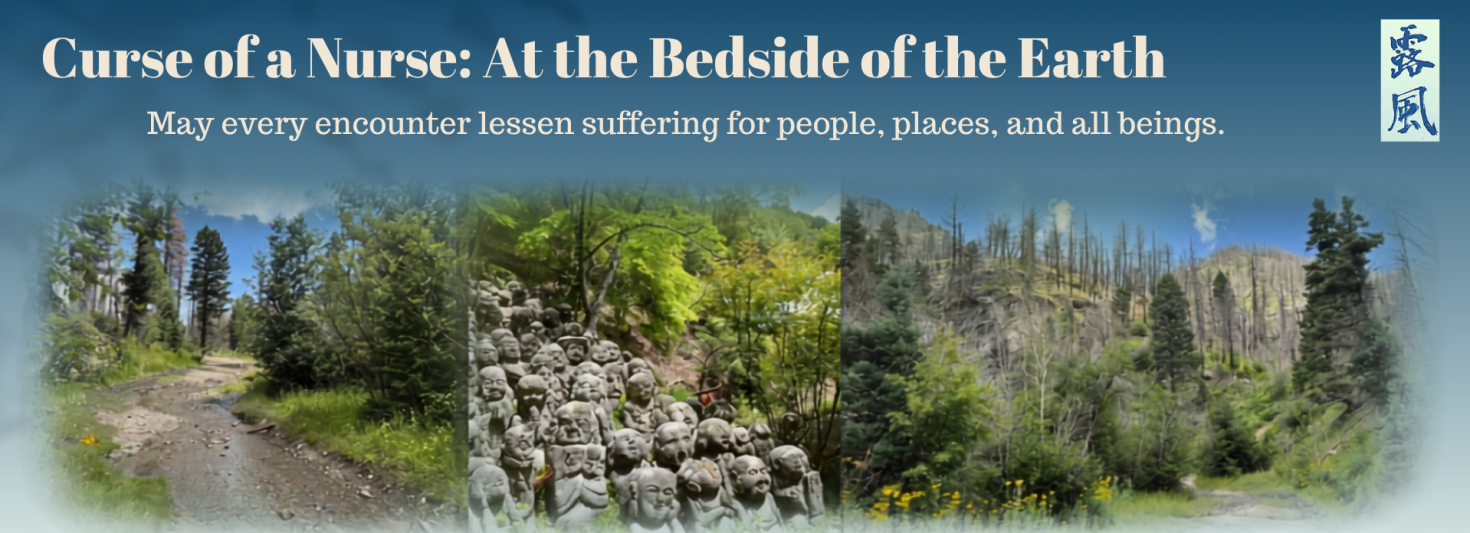
Through the Lens – Wounded Landscapes


An Invitation
This site is for anyone who feels the weight of what is happening to our planet and is looking for a different way to carry it.
Whether you are an environmental activist searching for sustainable ways to stay in the fight, a journalist covering stories that don’t have easy endings, a community organizer trying to hold space for a neighborhood in crisis, a contemplative practitioner bringing your practice to the world’s suffering, a nurse or healthcare worker who carries the invisible burden of bearing witness — or simply someone who wants to understand the intersection of compassion, crisis, and presence — you are welcome here.
I don’t have all the answers. But I have learned this: the most powerful thing we can do in the face of overwhelming suffering is to not look away.
Welcome. Let’s bear witness together.
Background
- Buddhist Priest (Soto Zen)
- Environmental Chaplain
- Captain (retired), U.S. Public Health Service Commissioned Corps
- Professor & Regent’s Professor, University of New Mexico College of Nursing
- Director, Center for Health Equity: Planetary Health and Preparedness
- Former Director, HHS Secretary’s Command Center (9/11 response)
- Former Director, Office of Human Services Emergency Preparedness & Response
- Former Chief of Staff, Office of the Assistant Secretary for Preparedness and Response
- PhD, Nursing — Uniformed Services University of the Health Sciences
- MA, Emergency & Disaster Management
- MSN, University of Tennessee
- BA, Psychology (Minor: Religious Studies)
- USPHS Distinguished Service Medal
- Hospice Care Companion


Compassion: sympathetic consciousness of others’ distress together with a desire to alleviate it.
Policy: a definite course or method of action selected from among alternatives and in light of given conditions to guide and determine present and future decisions.
Compassionate Policy: A definite course or method of action is selected from among alternatives. It considers the given conditions to guide and determine present and future decisions. This is done sympathetically. It is conscious of others’ distress and shows a desire to alleviate it.
Share this:


