Sitting in the snow
Meditating on whiteness
Blustering wind’s soul
Share this:



 The snow on blue chairs
begins to melt with the sun
Birds chirp, Buddha hears
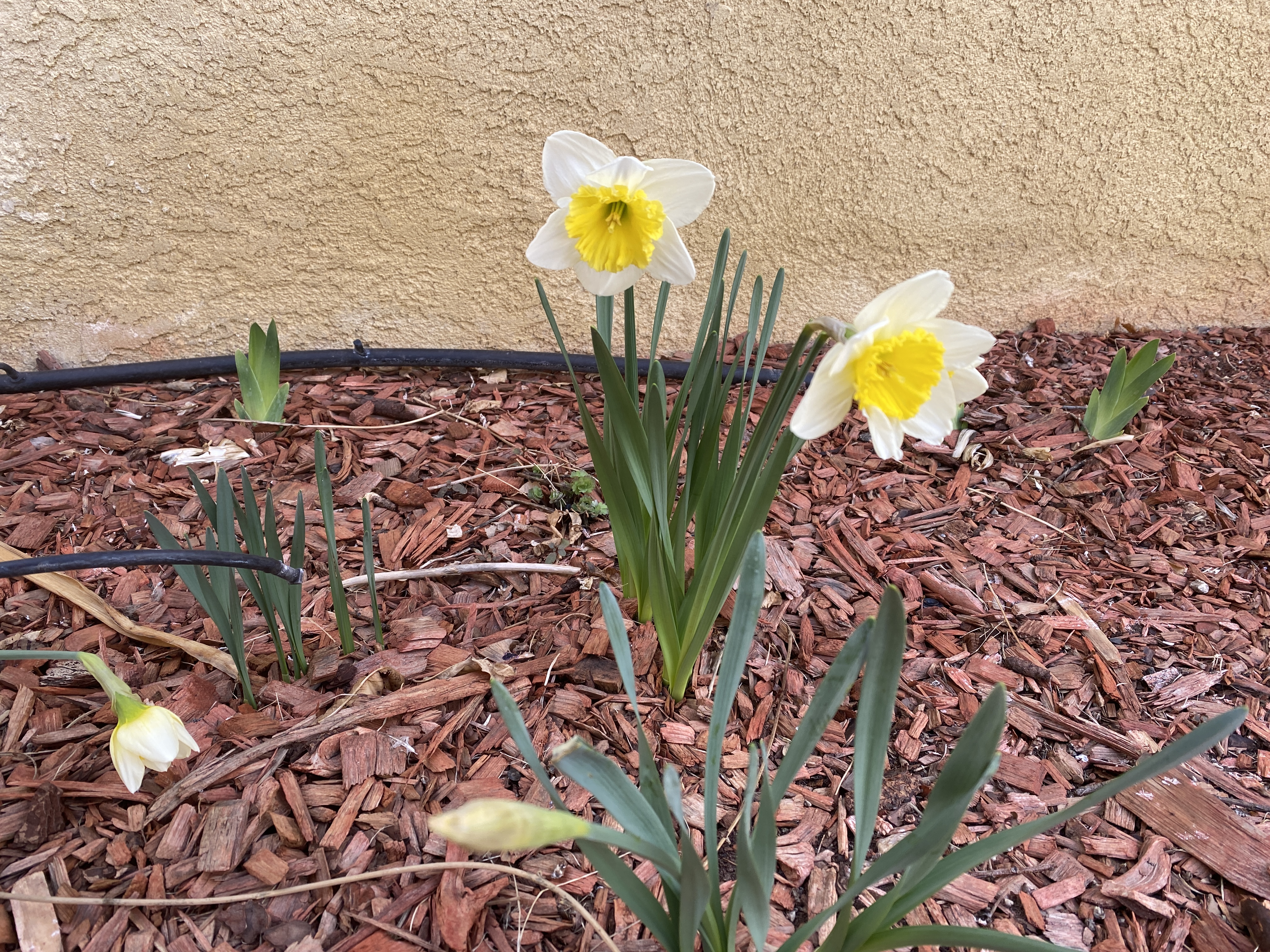
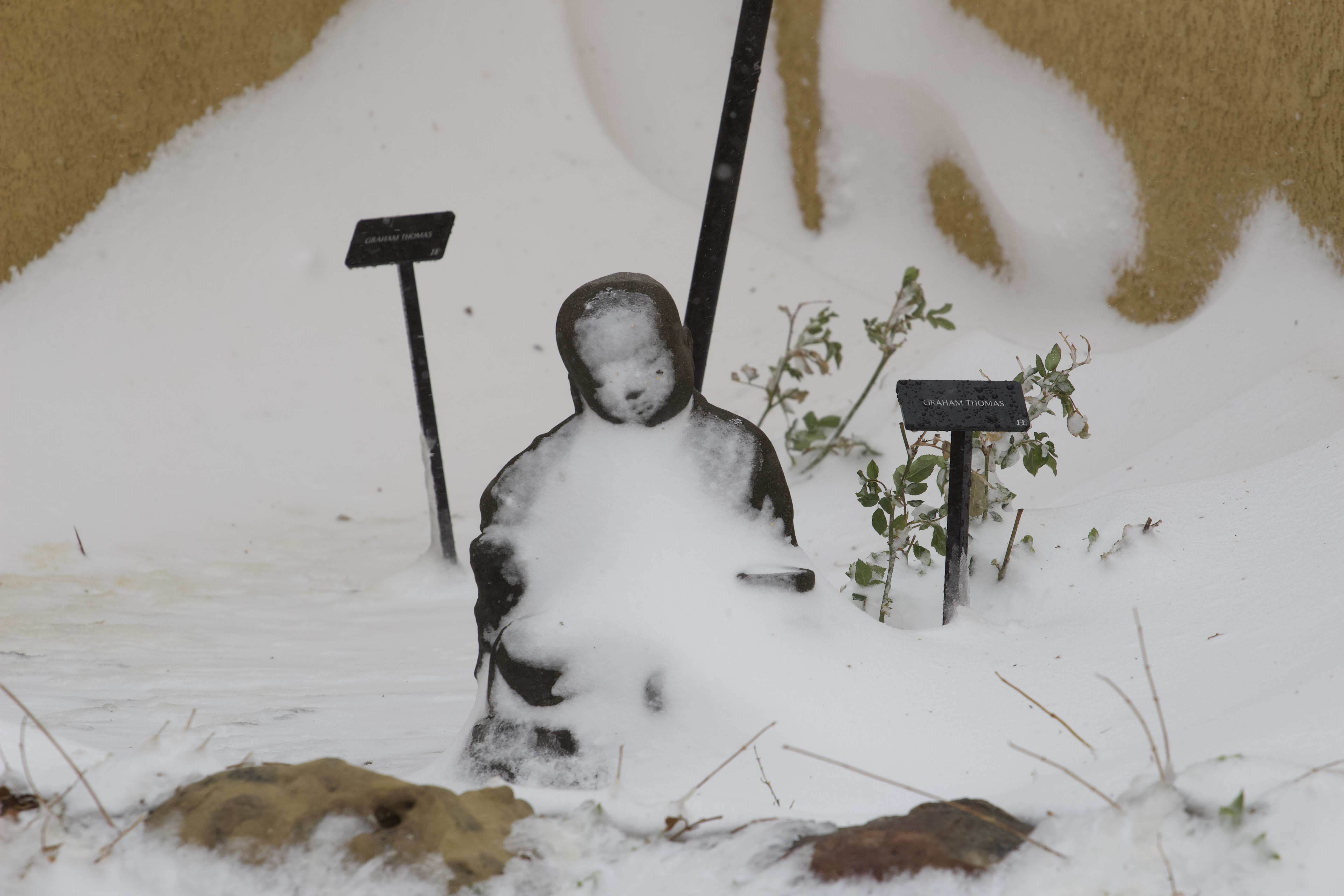
I was lulled into believing Spring was coming and bought new chairs in time for the snow. They sit empty in the snow watching and listening to the birds and communing with a cold stone Buddha.

The mountain warrior
disappeared with the snow
I will look for him
The snow is beautiful and with each passing moment it changes. In the desert the intensity of the sun quickly melts the snow away. It is much like life. I am in constant change and before I realize it the person I was melts into the person I am. What people see at any one point in time is me, but what do they perceive – the mountain warrior or the playful bear?

I was recently asked what I mean by social justice in nursing and public health preparedness. When I think of social justice in nursing and public health preparedness I think about the concept of a strong back and a soft front which I first read about in 2010.
We need a strong back to navigate this field of investigation and to enter into deep, transformative relationships with clients…It takes a strong back to listen, become a part of the story, be expected by the client to help (yet be uncertain just how to do so), and to sincerely proceed even in the midst of not knowing—and allow your open, soft heart to work in tandem with your strong back. The strong back provides for stillness in the face of client winds that violently shake branches but do not disturb roots. — Bein, Andrew. The Zen of Helping: Spiritual Principles for Mindful and Open-Hearted Practice (p. 10-11). Wiley Publishing.
I am reminded of my work at the Administration of Children and Families focusing on Disaster Case Management for the poor and underserved. Much of the disaster services were designed for those that have much. And many of the recovery actions focused first on the wealthy, landowners, and large businesses. For example, with Katrina and New Orleans, we saw the wealthy sections rebuilt quickly and in the poor sections there were limited attempts to rebuild. The city and Corp of Engineers blocked many efforts with justifiable reasons, but the reasons always seemed to favor those with power and wealth. We also saw generational poverty when houses were handed down without legal paperwork resulting in many not being able to even prove their home was their home.
We see it even now with COVID. We only need to look at who receives vaccines first to know that all things are not equal. Some take greater risk, but many at the top of the list had no greater risk (Congress as an example). But how many high school graduates who have to go to work every day to keep the water running, the trash picked up, the grocery shelves stocked were on any of the priority lists? What about vaccines being given out at Publix? Are there any Publix stores in poor neighborhoods?
Last week I was reminded of a strong back and a soft front listening to a talk by Joanna Macy and Joan Halifax. In short, they said we also need a focus on social action, social justice, and social transformation to eliminate institutional and structural violence. Imagine if we eliminated institutional and structural violence in the way we approach policy, education, practice, and research. What if we ask:
We know that after a disaster, or illness, the greatest needs fall in the bottom two rungs of Maslow’s hierarchy and needs and yet the majority of the resources after a disaster go to the people that have the ability to meet those needs for themselves. Thus with every disaster, those at the lower socioeconomic level, those already marginalized, those already facing discrimination have their situation exponentially exacerbated.
I don’t recall if it was Joan Halifax or Joanna Macy that ended by saying:
It is a moral imperative not to be morally disengaged.

There is nothing like having a Priest pull up your profile and then post it saying you aren’t Catholic because you love Zen to get one thinking about books to read or reread and all the reasons I love Zen. I think Richard Rohr captures it best.


“You have heard that it was said to the men of old, ‘You shall not kill; and whoever kills shall be liable to judgment.’ But I say to you that every one who is angry with his brother shall be liable to judgment” (Mt. 5:21-22).
Wednesday my husband called me and said turn on the TV. It is never good when you get such a call. It always means something awful and shocking just happened. The longer I watched the more my anger grew. Usually it quickly fades and in a few minutes I am able to adjust my emotions and my perspectives, but not this time. In the hours that followed the attack on the Capitol there were comparisons with BLM protests in the last year and how protesters were treated by the police. There was a brief moment when I wondered why all the reporting was about race rather than political ideology, but race is the political ideology of the insurrectionist and those that supported and encouraged them. What followed was a moment of realization that we have repeated the deification of the founding father in all aspects of our society. Our government was created by white men who saw everyone else as less than and now we are expected to revere them and believe that their original view was inspired. We are asked to believe that men that enslaved others and thought of women as property without rights should still be honored for their perspectives rather than admit they were men who reflected the local politics of their time. I love my country, but I do not like where it is headed. The mentality that idolized the founding fathers has been recreated over and over in our society.
The more I learn about the people and the events of January 6, the more I realize that we have been avoiding the truth our society has been hiding. The government was designed by white men, for white men and to this day is mostly governed by white men. Is it then any surprise that a significant number of Americans openly support white supremacist ideology and the associated domestic terrorism? It is all most Americans have ever known. How can anyone be surprised that the vast majority of the insurrectionists attacking the Capitol were white and predominantly male? We have taught them throughout their lives that they are superior and their wants and needs take priority.
Throughout the following days many professional organizations issued statements. Let me use the American Nurses Association (ANA) as an example because it is an organization to which I regrettably belong. ANA changed their policy and chose not to endorse a Presidential candidate for the first time in my adult life. Then they posted a condemnation of the violence and yet they supported the man that incited it. I wish it ended there, but one nurse pointed out online that the ANA has long been on the wrong side of race and gender based politics. I had not realized the ANA did not admit Black nurses until the mid 20th century or that they opposed the equal rights amendment until 1975. What I did realize is that when they revised their recent definition of nursing and in the background information they cited predominantly the same white women that historically defined the profession. They did embarrassingly little to call out racism and the impact it has on profession and the care we provide. In light of their change to the endorsement policy, which seemed designed to keep from opposing Trump, is there any question that they maintain the same ideology that got us to this point. Like those that idolize the all white, all male founding fathers the ANA seems to still idolize the all white, all female “founders” and theorists. Are we surprised they supported those that continue to endorse white supremacy and like the other rats abandoning ship now offer words of unity when they failed to speak out when it was obvious where this was headed?
The American Association of Colleges of Nursing (AACN) also put out a milk toast statement that didn’t even bother to condemn the violence but rather to focus on what unites us rather than divides us. There is nothing that unites me with an insurrectionist that attempted a violent overthrow of our government. Again, why should this surprise me. The AACN has long had a hierarchy that does not represent academia, but rather the Deans. The only voting representation are deans or their equivalent of Colleges of Nursing. The Deans of US colleges of nursing are predominately White women and the leadership of the AACN throughout its history has been predominantly White women. Is it surprising that they want to focus on what units us? It is much easier than focusing on a legacy of exclusion of people of color in leadership roles. I appreciate their work in increasing diversity, but I think their statement was tone deaf.
“Anger that is motivated by compassion or a desire to correct social injustice, and does not seek to harm the other person, is a good anger that is worth having.” His Holiness the Dalai Lama
I need to acknowledge my anger and focus it toward social justice in the area of the world in which I work, nursing. In the word of Matthew Dowd, if we “really want to heal this country then the need to go through the four Rs of dealing with what they [we] have done: responsibility, regret, resolve, repair. Take responsibility. Express regret. Resolve to do better. Repair the damage they have done.” It may seem an insurmountable task to fix the racism and the racially charged politics that lead us to this day, but it is possible for each of us to have eyes to see and ears to hear. It is possible to identify the history, policy, practices, and attitudes that were designed not to be inclusive all but to prioritize some.

Distribution of COVID vaccines once again has me thinking about the importance of volunteerism in public health preparedness and the role of nurses in volunteering their time and talents. Volunteerism has been part of the American culture since the 1803 Portsmouth, New Hampshire fire that resulted in the first legislation that dealt with the need for emergency preparedness. Since that time emergency response has largely depended on volunteers. Following World War II, the Department of Health, Education and Welfare (1961) recognized that nurses have conflicting roles and responsibilities and the Department also acknowledged the critical need for nurses during a disaster. The government’s attempts to ensure nurses availability and willingness to respond during a disaster resulted in the recommendation to remind staff of their responsibility as public servants – all nurses were considered public servants. In today’s terms we may call them essential workers. Unfortunately, there remains little emphasis on educational training in disaster response at any level in nursing education. Despite the efforts of the AACN to include disaster preparedness in the Essentials documents there is little done to ensure schools of nursing comply.
A volunteer is any paid or unpaid person who offers to perform a service of his or her own free will. Four categories of volunteers are: (1) professional responders, (2) trained responders, (3) citizen volunteers, and (4) spontaneous unaffiliated volunteers (SUVs). No one questions whether professional and trained volunteers should be utilized during a disaster. However, the new public health threats –pandemics; terrorism; and changing expectations of citizens –challenge the government and private sector organizations to adopt new systems that make more effective use of volunteers. I accept the premise that a large-scale disaster will require more trained professional nurse responders than are presently available. Thus it is likely, as we are seeing in the current mass vaccination campaign that there is a need to use students and faculty as volunteers.
The 9/11 attacks in 2001 and Hurricanes Katrina and Rita in 2005 forced the realization that disasters occur requiring the use of volunteers in addition to professional and trained responders, even in a country with tremendous resources, such as the U.S. The U. S. Public Health Service (USPHS) had the largest deployment of nurses in its’ history in response to the 2005 hurricanes (may have been exceeded by COVID), yet this number of deployed nurses was not adequate enough to fill the need. In addition to the USPHS, the American Red Cross (ARC), Medical Reserve Corps (MRC), and all three components of the National Disaster Medical System (NDMS) (medical teams, patient movement, and definitive care) were utilized. NDMS deployed approximately 5174 personnel, the majority of who were trained volunteers and full-time employees of the NDMS.
In an attempt to handle the outpouring of compassion from medical personnel that wanted to help in the response to the hurricanes in 2005, the Department of Health and Human Services (HHS) created a website and process to register and credential those wishing to volunteer who were not already part of established systems such as NDMS or ARC. Through the website and phone banks over 34,000 people signed up to become temporary unpaid federal workers. Three thousand eight hundred forty-two healthcare personnel that volunteered were credentialed through Credential Smart in 3 weeks and over 1,200 were deployed. This is why it surprised me to get push back from nurses about volunteering to give COVID vaccines when I mentioned it online. Why was there so much desire to help during Hurricane Katrina and so much less during COVID?
Federal, state, or local, systems can be logistically difficult for volunteers. The level of protection the volunteer receives is based on the type of disaster declaration from local to federal. Moreover, states have licensure requirements for nurses to protect the safety of the public by preventing unqualified persons from practicing as a nurse. Some states offer licensure reciprocity to member compact state (e.g., Tennessee, Maryland, Virginia, etc.), while other states waive or grant licensure reciprocity for nurses during emergencies. Fortunately COVID-19 vaccines are covered countermeasures under the Countermeasures Injury Compensation Program (CICP).
An important consideration for nurses who volunteer is legal liability. In addition to licensure and scope of practice issues nurses must consider basic legal liability protection. Coverage from state to state varies; some provide coverage for Tort Claims, Worker’s Compensation, and Good Samaritan laws, while others do not. Some volunteers will also be covered under the Volunteer Protection Act of 1997 (Public Law 105-19), which protects volunteer clinicians working in nonprofit organizations from lawsuits for simple negligence. Hodge (2005) identified three factors on which legal protections depend, (1) the profession of the volunteer, (2) the person or facility to which the service is being provided, and (3) the existence of an emergency declaration. During the early phases of the COVID response we say Governors doing executive orders for everything from liability coverage to changes in scope of practice.
Federal government. HHS has the authority to hire unpaid federal employees, which provides them liability protections and resolves issues of state licensure.
State registries. Emergency Management Assistance Compacts (EMAC) now exist in 49 states and provide a broad immunity and tort liability coverage for responders (Hodge, 2005b) and additionally provides for licensure reciprocity during a disaster declared by the governor if the nurse is responding through the EMAC. Those SUVs who responded on their own were not covered.
One of the items authorized in the Bioterrorism Act was the creation of ESAR-VHP to address the issues of credentialing healthcare professionals following 9/11. The system has established interoperable, state-based registries of healthcare professionals who have pre-identified themselves as persons willing to respond to a disaster. The state then has the ability to verify their credentials and training in advance. Additionally, many states have adopted a version of the Center for Public Health Law’s Model State Emergency Health Powers Act (MSEHPA) that allows for such actions as waiving state licensure requirements for healthcare personnel from other states, thus providing some level of liability protection when a public health emergency is declared.
Hospitals. In addition to the state licensure requirements, nurses must also be credentialed by the hospital at which they will be working. This process is very time-consuming under normal circumstances and may be impossible in a disaster . The Joint Commission for Accreditation of Healthcare Organizations (JCAHO) requires accredited facilities to have a system in place to grant privileges during a disaster.
Professional associations. Professional associations have the ability to encourage large numbers of nurses to volunteer, but generally lack the financial resources for registries. However, because of their leadership in the profession and ability to partner with state and federal organization, they potentially can have a significant impact. For example, through a partnership between the Georgia Nurses Association, Georgia Nurses Foundation, ARC, Georgia Board of Nursing, and Georgia Department of Human Resources, the Georgia Nurse Alert System was developed to identify licensed nurses who have the skills to deploy during a disaster, Similar partnerships have developed in other states. Professional organizations such as the American Nurses Association (ANA) are encouraging a model state legislative act through the National Conference of Commissioners on Uniform State Laws to establish a uniform law dealing with volunteer healthcare services during a disaster. A law that addresses the licensure recognition and scope of practice issues during a disaster is definitely needed, but the National Council of State Boards of Nursing will not consider any special considerations for disasters and instead wants people to buy into their current compact and consensus models. This is not likely to happen and thus leaves us unprepared. It is also a prime example of inflexibility that still rules much of the nursing hierarchy at the state and national level.
Disaster response depends on volunteers who are trained and organized through programs such as the DMATs, MRC, ARC, or local hospitals and public health organizations. Disaster response does not/should not depend on the SUVs that show up to disaster sites. These SUVs are not part of organized teams and their identification and credentials are not verified; thus, they should not respond to a disaster because they can impede the response. The MRCs are now robust and exist in almost every community. It would be helpful if as part of every nursing program students were encouraged to join one of these organizations to help ensure their personal preparedness.
The extent to which volunteers are credentialed in advance of an emergency does affect the ability of hospitals to utilize them. In response to the problems with credentialing Congress directed the HHS Secretary to develop ESAR-VHP. Nonetheless, while ESAR-VHP provides advanced credentialing verification, hospital administration is not relieved of their JCAHO requirements to credential volunteers and grant privileges based on primary source verification. The size of the disaster will likely be the deciding factor in how much information a hospital requires. The often-cited case of New York City’s ability to utilize health professional volunteers after the World Trade Center attack still remains a prime example of the inability to utilize them due to the challenges imposed when attempting to verify volunteers’ identities, licensure, credentials, and training.
Not surprisingly, nurses are the most requested health professional for most types of disasters. A combination of modeling supported by the Agency for Healthcare Research and Quality and past experience in deployments led to estimates for the number of nurses required to respond to a disaster ranging from a low of 436 for hurricanes to a high of 507,150 for a pandemic. The federal, state, and local professional responders, such as USPHS officers and DMATs, could easily deploy 436 nurses, but the concern is for how long. All of the nurses have full-time jobs elsewhere, frequently in direct patient care settings. However, the total number of federal nurses and DMATs combined do not equal 507,150. Therefore it is necessary when considering worst-case scenarios to include citizen volunteers and to enhance the existing ability to effectively and efficiently identify, credential, and utilize those volunteers including students and faculty.
I have long recognized that I consider nursing more than a job. It is my passion and my life’s work. Nurses, physicians, and all those in healthcare that must do their jobs during this crisis do so with dedication and more than a little bravery and self-sacrifice. At this moment we are asked to help with vaccinations for our neighbor and our country. It is an opportunity to engage students in service learning.
The best way to find yourself is to lose yourself in the service of others. — Mahatma Gandhi
Serving selflessly includes taking the time to model desired behaviors we hope to instill in students. We can show this to them through service learning and shared volunteering. Service learning is a strategy that integrates community service with guided instruction and student reflection to elevate the learning experience, teach civic responsibility, and strengthen communities. The last 10 months have convinced me that it is more important than ever to come together as a community, instill in students the desire to serve humanity with shared purpose and goals, and move out of our own comfort zones. It is one thing to read about mass vaccinations in a book and another to have hands on experience.
It is easy for me not to be concerned about giving my time and labor for free to some of these activities. I am well paid and that pay largely comes from tuition and taxes. Many students do work to afford their education and while they may want to volunteer they may not have a lot of free time. One solution to this issue is incorporate mechanisms for student to build up service learning hours that may count for clinical time even during semester breaks. In fact, this may provide greater balance to their schedule and provide working students the same opportunities as students from privileged backgrounds. We need to find ways to be more flexible and that may take us back to liability coverage that covers students between semester breaks. As a person that worked full time while doing my undergraduate degree and my PhD I understand that work is often not optional and scholarships for nurses in graduate programs are limited. Surely we can do better.