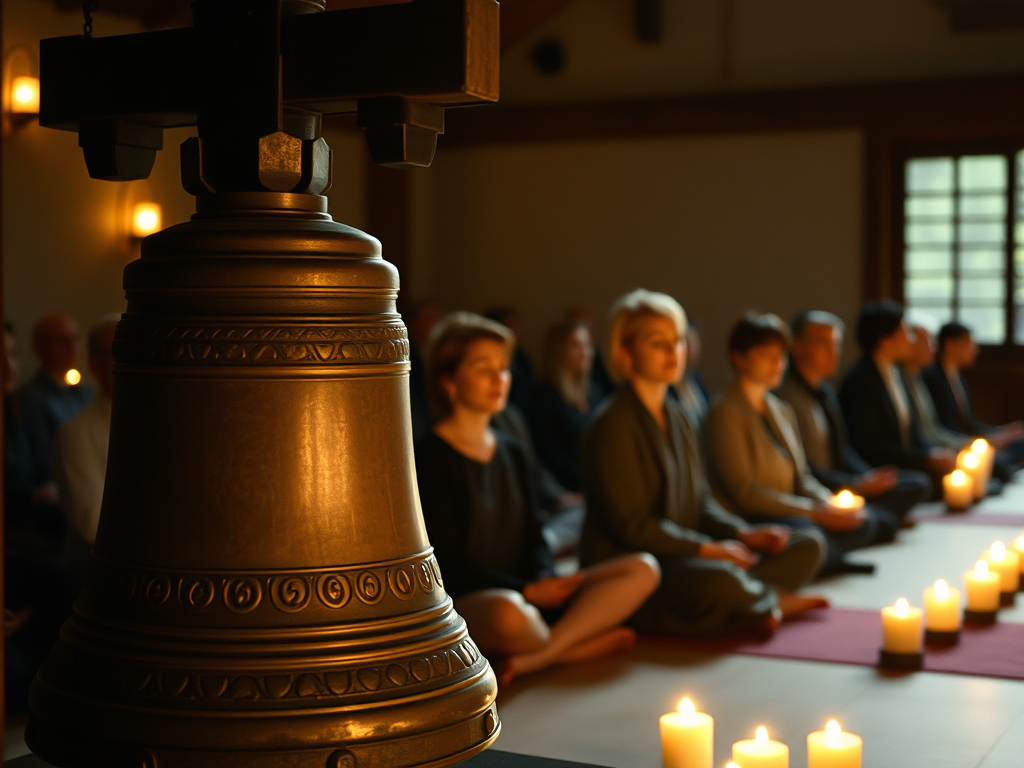
Embracing Stillness: New Year Reflections

As the clock struck midnight, I sat silently at Upaya Zen Center, immersed in zazen. There was no countdown, no fireworks, just the gentle rhythm of my breath and the profound stillness of sitting together in the community. As 2024 ends, I shared in the tradition called the Bells of New Year’s Eve. The bells mark the transition into the new year with the ringing of the temple bell 108 times. Each bell is rung and allowed to resonate until the sound fades away. In Buddhist teachings, the number 108 represents the delusions and desires that cloud our minds and lead to suffering. Each chime of the bell is a symbolic act of releasing these burdens, cleansing the heart and mind, and preparing to greet the new year with clarity and compassion.

The sound of the bell oddly adds to the stillness of the night, creating a space for reflection and mindfulness. As the final bell echoes into the new year, it’s a reminder of impermanence and renewal—an invitation to step into the future with a fresh perspective, an open heart, and a commitment to peace. Whether heard in person, online, or in spirit, the Bells of New Year’s Eve offer a moment of profound stillness and hope for the year to come. It gives us a moment to remember those who passed this year.

Remembering a Friend


This year, I remembered Jeff Cabbage—a remarkable man whose life was a testament to joy and love. When I graduated with my MSN, his wife Lori, radiant and expecting their first child, was walking across the same stage. Over the years, Jeff and I stayed connected through Facebook and shared a passion for Tennessee Volunteer football. He became a constant reminder of the power of a simple smile, the profound impact of being a devoted father and husband, and the value of hard work.

Though life is impermanent and ALS ravaged his body, it could not touch the strength of his spirit. His life came to an end, but his smile remains etched in my heart, a source of warmth. I ache for Lori, their children, grandchildren, and all who loved him, but I carry his memory forward as a beacon of the love he embodied. I felt an overwhelming sense of peace and hope for 2025 in that quiet moment.

No Resolutions: Only a Promise

The New Year often arrives with resolutions—promises to improve ourselves, our habits, or our lives. This year, I’ve chosen a different path. Rather than resolving to change something internal, I am making a promise: a vow to embody the principles of my life as a Soto Zen priest. I promise to work tirelessly for environmental justice, peace, and compassion.

As I step into this new year, I recommit to living my vows as a Soto Zen priest by embodying the teachings of the Triple Treasures, the Three Collective Pure Precepts, and the Ten Great Precepts. These vows are not mere words; they are a guide for how I aim to walk through life with clarity, compassion, and purpose.

From generation to generation, Buddhas and Ancestors have transmitted the Triple Treasures—Buddha, Dharma, and Sangha. I will honor the Buddha as an embodiment of awakening, follow the Dharma as a path to wisdom, and nurture the Sangha, the community of practice, with care and respect.

The Three Collective Pure Precepts call me to live with a pure heart: to abstain from unwholesome actions, to cultivate wholesome actions, and to dedicate myself to the benefit of all beings. These precepts remind me that every choice I make—large or small—can contribute to a more compassionate world.

The Ten Great Precepts provide the structure for this practice. They guide me to abstain from actions that cause harm—whether through taking life, stealing, dishonesty, or ill-will—and to nurture qualities that bring healing, generosity, and understanding. These vows challenge me daily to step beyond self-interest and live in alignment with my deepest intentions.

Keeping these vows means living with humility, mindfulness, and a commitment to serve. It means showing up for others, even when it’s difficult. It means striving to see the Buddha-nature in all beings and working to create peace, justice, and compassion wherever I can.

This is my promise—to carry these vows into every moment of my life to honor the teachings, my community, and the world we share.

This promise is not new, but the new year offers a moment to recommit. The world’s challenges—climate change, violence, inequality—can feel overwhelming. But I believe in the transformative power of small, deliberate actions. I often read posts from my rural hometown in Tennessee and see neighbors helping neighbors. I don’t see the hate-filled posts of anonymous people. Sitting in Zazen reminds me that every moment is an opportunity to choose peace, cultivate compassion, treat everyone as a small-town neighbor, and live in harmony with all beings.

Invitation to Sit

As we enter this new year, I extend an invitation: sit with me. You don’t need to have experience with Zen practice or meditation or prayer or profess any religion. You only need the willingness to pause, breathe, and be present. Together, we can create a ripple of stillness and clarity that extends far beyond ourselves.

May this year be one of peace. May compassion spread like sunlight, touching everything in its path. And may we, together, nurture the world with our thoughts, words, and actions.

Happy New Year.
Let us sit together at https://www.youtube.com/@MissouriZenCenterMitras/streams, or email me, and I can send you a Zoom link.


Where to Begin

My cousin wanted to know where he could learn more about Buddhism and meditation. My first thought is to read Zen Mind Beginners Mind by Shunryu Suzuki. However, knowing how busy many people are and how much some young people dislike reading, I found a free online recorded version. If you are interested, this is a good starting point.

Zen is not for the faint of heart. Everyone must sit in silence; sometimes, silence reveals one’s true self, fears, and hidden thoughts.

Begin by focusing on the breath. Sit quietly and pay attention to your breathing. This foundational practice requires no prior experience and can be deeply calming. While I sit for 30-40 minutes at a time, some recommend starting by sitting zazen for 5-10 minutes. The focus one finds while sitting should then be carried into daily activities, such as eating, walking, or cleaning.

Sitting is not magic and is not about achieving perfection. As with many practices, having a community’s support, which we call a sangha, is very helpful. If there is no local community, many zen centers have online communities.

We call sitting our practice. We practice without judgment. Imagine life is like gardening. Zen practice is like gardening. It is about care, patience, and being present in the process. Our practices teach us to nurture life with mindfulness and to accept what arises, trusting that the garden will grow naturally into something beautiful with gentle attention.


Reflections on Expectations

Expectations and realities are often different. I expected my shaved head to feel smooth and silky. Instead, it feels more like Velcro. It sticks to my shirt and pillowcase. A friend, who is a cancer survivor, suggested that I get a satin pillowcase, which is what she did when she lost her hair. I did not expect to keep reaching to ring out my hair when I got out of the shower or to move it out of my eyes when I was reading. So many behaviors are habits without thought.

Cikd wind of winter
Sweeping leaves from the walkway
Winds blow away though
I expected smooth
Sore back, aching thighs - choki
Finding nirvana
Warmer and sunny
Zazen, Samu, Tokudo
Walking in the rain

I am humbled and grateful for the opportunity to walk this path of Soto Zen and to have experienced Tokudo.

Tokudo means attaining salvatio/nirvana (no wind of karma): May all attain nirvana/awakening to be saved from a long night of nescience (no witness of nirvana)! — Rosan Daido

This journey has been one of humility, learning, and inner transformation. I honor my teachers, whose wisdom and compassion have guided me, and the sangha, whose presence reminds me of our shared connection. This path continually inspires me to live with greater mindfulness, compassion, and service to all beings. My heart is filled with gratitude for the unfolding of this sacred journey.

I took sixteen vows to honor the profound path of awakening and to embody the timeless wisdom of the Triple Treasures: Buddha, Dharma, and Sangha. These precepts guide my heart and help me align my actions with compassion and dedicate my life to the benefit of all beings. Through the Three Pure Precepts and the Ten Great Precepts, I vow to cultivate mindfulness, integrity, and selflessness, aspiring to live a life that reflects the teachings of the Buddhas and Ancestors and contributes to the harmony and well-being of the world.

The Triple Treasures

From generation to generation, all Buddhas and Ancestors have deeply respected and transmitted the Triple Treasures:
Buddha,
Dharma
Sangha

The Three Collective Pure Precepts

With purity of heart, vowing to abstain from the unwholesome.
With purity of heart, vowing to do the wholesome.
With purity of heart, vowing to benefit all beings.

The Ten Great Precepts

A disciple of the Buddha abstains from the willful taking of life.
A disciple of the Buddha abstains from stealing.
A disciple of the Buddha abstains from indulging in sexual greed.
A disciple of the Buddha abstains from telling lies.
A disciple of the Buddha abstains from indulging in harmful intoxicants.
A disciple of the Buddha abstains from speaking ill of others.
A disciple of the Buddha abstains from extolling the self while slandering others.
A disciple of the Buddha abstains from being avaricious in the bestowal of teachings or materials.
A disciple of the Buddha abstains from the harboring of hatred, malice or ill-will.
A disciple of the Buddha abstains from denouncing the Triple Treasure.

Heart Sutra
The Venerable Avalokiteshvara Bodhisattva,
when carryʼng out the profound Prajnaparamita career,
penetrated through the five aggregates and saw that they are Shunya in their nature.

Here, Shariputra, Form is Shunyata; Shunyata is Form.
Form does not differ from Shunyata;
Shunyata does not differ from Form.
That which is Form is Shunyata;
that which is Shunyata is Form.

The very same applies to feeling, idea, formations and consciousness.
Here Shariputra, all Dharmas are marked with Shunyata;
Neither originated nor destroyed;
neither defiled nor undefiled;
neither decreased nor increased.

Therefore, Shariputra, in Shunyata, no form, no feeling, no idea, no formation, no consciousness;
no eyes, ears, nose, tongue, body, mind; no form, sound, smell, taste, touch, mind-object;
no eye-realm and so forth until no mind-consciousness-realm;
no nescience, no extinction of nescience,
and so forth until no old age and death;
no extinction of old age and death;
no suffering, origination, cessation, path; no knowledge, no grasping.

Therefore, in no grasping one lives in no mind-hindrance, relying on the Prajnaparamita of Bodhisattvas,
because there is no mind hindrance and no fear, one settles in Nirvana, transcending the perverted views.

All the Buddhas residing in the three times are awakened to the unsurpassed right Awakening, relying on the Prajnaparamita.

Therefore, know the Prajnaparamita, the Great Mantra, the Great Wisdom Mantra, the Unsurpassed Mantra, the Peerless Mantra,
which brings cessation of all sufferings;
which is true, as it is not false.

The Mantra in the Prajnaparamita is uttered thus: Gate • Gate Para-Gate • Para-Sam-Gate Bodhi Svaha.

Thus ends the heart of Prajnaparamita


Leadership Through the Lens of Mary Lou Anderson’s “Leaders”

I remember meeting Mary Lou Anderson when I was in leadership training as an officer. Her poem stuck with me for the last 25 years and has always influenced how I envision leadership. Her poignant words from her 1970 House of Delegates Address encapsulate a profound vision of leadership. Mary Lou Anderson articulates a leadership ethos that transcends conventional paradigms, urging leaders to embrace the challenges of shaping history.

The Lonely Stand of Leadership

Anderson introduced a vivid image of leaders standing in the “lonely place, Between the no longer and the not yet,” portraying the unique position leaders find themselves in — a space filled with uncertainty yet overflowing with potential. Difficult decisions are the essence of leadership: navigating uncharted waters with the courage to make decisions that will forge the future. It emphasizes the solitary journey of creating impactful, pivotal choices that impact history. It may only be the history of one organization, but what are the ripples of that history?

The Call to Courage and Risk

Defying the allure of popularity, safety, and conformity, Anderson puts out a call of leadership characterized by bravery and risk-taking. Her belief that “We are not called to be popular, / We are not called to be safe” highlights the essence of leadership as the capacity to make uncomfortable decisions that may defy immediate approval for transformative change. She celebrates the audacity required to challenge existing norms, change mindsets, and take bold steps toward creating a more equitable world.

The Gamble for a Better World

She ends with an appeal for leaders to “gamble our lives / For a better world,” emphasizing the altruistic aim of leadership. This powerful statement underlines leadership as a selfless quest for societal improvement, emphasizing a commitment to the collective good over personal accolades. The use of “gamble” accentuates the unpredictability and sacrifices intrinsic to the leadership journey, portraying true leaders as those prepared to risk everything for the benefit of others.

My Vision Formed by Mary Lou Anderson

“Leaders” by Mary Lou Anderson profoundly reflects on the essence and challenges of leadership. Through her depiction of a leader’s role, Anderson, in our leadership training, provided us with a vision of leadership, championing a model based on courage, risk, and altruism. In a world constantly evolving, her message remains pertinent, calling upon leaders to rise to the noble task of historical transformation. I find her words still guide me and inspire me.

LEADERS

Leaders are called to stand
In that lonely place
Between the no longer and the not yet
And intentionally make decisions
That will bind, forge, move,
And create history.

We are not called to be popular,
We are not called to be safe,
We are not called to follow.
We are the ones called to take risks,
We are the ones called to change attitudes,
To risk displeasure,
We are the ones called to gamble our lives
For a better world.

House of Delegates Address 1970
Mary Lou Anderson

Why Faculty Freedom is a Hill Worth Defending


Introduction

In the ever-evolving landscape of academia, the principle of faculty freedom stands as a bulwark against the encroachments on intellectual liberty and academic independence. Rooted in the conviction that the pursuit of knowledge thrives in an environment free from undue influence, this principle is more than a mere academic luxury; it is the very foundation upon which scholarly inquiry and educational excellence are built. The American Association of University Professors (AAUP) has long championed this cause, advocating for the rights of faculty to research, teach, and express ideas without fear of reprisal or censorship.

“The academic freedom of faculty members includes the freedom to express their views (1) on academic matters in the classroom and in the conduct of research, (2) on matters having to do with their institution and its policies, and (3) on issues of public interest generally, and to do so even if their views are in conflict with one or another received wisdom.”

AAUP Statement, 1994

The Essence of Faculty Freedom

Faculty freedom encompasses several key dimensions: the freedom to conduct research and disseminate findings, the freedom to teach and discuss ideas in the classroom, and the freedom of extramural expression. This triad of freedoms ensures that academics can engage in scholarly pursuits without external pressures dictating the bounds of their inquiry.

  • Research and Publication: Academics must have the liberty to explore, discover, and communicate knowledge without censorship or restrictions imposed by political, corporate, or institutional interests.
  • Teaching: Educators should have the autonomy to design curricula and present material that reflects their expertise and pedagogical philosophy, fostering a vibrant and diverse educational environment.
  • Extramural Expression: Faculty members should express their opinions as citizens without institutional discipline, provided their speech does not impede their professional duties or the university’s operation.
  • Policy Input: An often overlooked but equally crucial aspect of faculty freedom concerns the role of faculty in institutional governance and policy-making. This dimension emphasizes the importance of faculty input on matters that affect their institutions’ academic mission and operations.

Why It’s a Hill Worth Dying On

  1. Foundation of Academic Integrity: Faculty freedom is integral to maintaining academic integrity and the pursuit of truth. It protects scholars from ideological, political, or financial pressures that could compromise their research’s objectivity and rigor.
  2. Catalyst for Innovation and Progress: History shows that academic breakthroughs often challenge prevailing wisdom. Faculty freedom provides a safe haven for radical ideas and unorthodox inquiries essential for scientific and societal progress.
  3. Guardian of Democracy: Faculty freedom contributes to an informed and engaged citizenry by fostering critical thinking and open debate. It ensures that higher education institutions remain spaces where difficult conversations can occur, preparing students to navigate and contribute to a complex world.
  4. Shared Governance: The concept of shared governance is central to academic freedom. It posits that faculty members, by virtue of their expertise and experience, should have a significant voice in decisions that affect the curriculum, educational standards, and the overall direction of the institution. This includes policies related to faculty appointment, tenure, promotion, and broader university policies.
  5. Ensuring Academic Priorities: Faculty involvement in institutional policy-making ensures that academic values and priorities guide decisions. Without faculty participation, there is a risk that financial or administrative concerns might overshadow the institution’s core educational and research missions.
  6. Protecting Academic Standards: Faculty members play a crucial role in upholding the quality and integrity of academic programs. Their freedom to engage in policy discussions related to course content, degree requirements, and assessment methods is essential for maintaining high academic standards.
  7. Advocating for a Supportive Work Environment: Faculty freedom also encompasses the right to advocate for policies that support a healthy work environment, including adequate resources for research, fair labor practices, and protections against discrimination and harassment. Such a framework is necessary for scholars to fully engage in their academic duties without undue stress or fear.

Practical Suggestion for Promoting Faculty Freedom

  1. Adopt Clear Policies on Academic Freedom
    • Develop Comprehensive Guidelines: Institutions should establish clear, comprehensive policies on academic freedom, including research, teaching, extramural expression, and participation in institutional governance. These policies should be developed in collaboration with faculty bodies to ensure they reflect the needs and perspectives of the academic community.
      Regular Review and Update: Policies should be regularly reviewed and updated to address emerging challenges and incorporate best practices in academic freedom.
  2. Implement Strong Tenure Systems:
    • Protecting Faculty from Undue Influence: A robust tenure system is one of the most effective mechanisms for protecting faculty freedom. Tenure provides faculty members with the job security necessary to pursue innovative research and teaching methods without fear of reprisal.
    • Transparent Criteria and Processes: Ensure that the tenure and promotion criteria and processes are transparent, fair, and rigorously adhered to, reflecting the institution’s commitment to academic excellence and freedom.
  3. Foster a Culture of Open Dialogue and Respect:
    • Encourage Open Discourse: Institutions should actively foster a culture where open dialogue, critical thinking, and diverse viewpoints are valued and encouraged. This involves tolerating and actively supporting the expression of a wide range of perspectives.
    • Addressing Harassment and Intimidation: Implement policies and mechanisms to protect faculty from harassment, bullying, or intimidation that could undermine academic freedom.
  4. Engage in Shared Governance
    • Inclusive Decision-Making: Actively involve faculty in the governance of the institution, including policy formulation, curriculum development, and other key areas. Shared governance ensures that academic priorities guide institutional decisions.
    • Support Faculty Governance Bodies: Strengthen and support faculty governance bodies, such as faculty senates or councils, ensuring they have a meaningful role in institutional governance.
  5. Provide Adequate Resources and Support
    • Support for Research and Teaching: Ensure faculty have access to the resources and support necessary for their research and teaching activities, including funding, infrastructure, and professional development opportunities.
    • Mental Health and Work-Life Balance: Recognize and address faculty pressures and stresses by supporting mental health and promoting a healthy work-life balance.
  6. Transparency in Institutional Policies
    • Clear Communication: Ensure that all institutional policies affecting faculty rights and responsibilities are communicated transparently and are readily accessible.
    • Regular Training: Offer regular training and workshops for faculty and administrators on academic freedom and the institution’s policies, promoting a shared understanding and commitment to these principles.
  7. Establish Mechanisms for Addressing Grievances
    • Fair and Impartial Processes: Create transparent, fair, and efficient processes for faculty to raise concerns and grievances related to academic freedom without fear of retaliation.
      By implementing these suggestions, institutions can create an environment that not only protects but actively nurtures faculty freedom, thereby contributing to the advancement of knowledge, the enrichment of education, and the fostering of a dynamic and inclusive academic community.

The AAUP’s Stance

The AAUP has been a staunch defender of faculty freedom since its inception in 1915. It argues that academic freedom is essential for the common good and believes that without it, the advancement of knowledge would be severely hampered. The association has established guidelines and principles that have been widely adopted by educational institutions to protect faculty rights and promote an atmosphere conducive to academic excellence.

The American Association of University Professors (AAUP) recognizes the importance of faculty participation in institutional governance as part of its broader advocacy for academic freedom. The AAUP’s statements and policies highlight the need for faculty to have a substantial voice in matters that affect the educational mission and faculty welfare. It advocates for structures and processes that facilitate meaningful faculty input into institutional policies, arguing that such participation is crucial for upholding the quality and independence of academic institutions.

Conclusion

Faculty freedom is not merely an academic principle; it is a cornerstone of a free and progressive society. Its defense requires constant vigilance and unwavering commitment from all stakeholders in the academic community. Faculty efforts to safeguard these freedoms should remind us of their value and the need to protect them at all costs. In a world fraught with increasing attacks on freedom, preserving the sanctity of academic inquiry is indeed a hill worth dying on.


Addressing Critical Issues and the Role of Faculty Governance

Faculty work to address critical issues affecting their communities. Eleanor Roosevelt once said, “Great minds discuss ideas; average minds discuss events; small minds discuss people.” As faculty, I hope we all aspire to be great minds and promote free speech.

Faculty governance is not merely a bureaucratic process; it is the bedrock upon which the principles of our institutions stand. It is a platform through which we can enact meaningful change, shape policies, and foster a culture of inclusivity and belonging. Faculty governance is longstanding and one of the best models of shared governance. In 1920, the American Association of University Professors (AAUP) wrote its first statement on faculty governance. Faculty should be involved in “personnel decisions, selection of administrators, preparation of the budget, and determination of educational policies” (AAUP). Faculty governance should include everyone who is impacted by a policy or decision. Most importantly, it is essential to academic freedom.

The academic freedom of faculty members includes the freedom to express their views (1) on academic matters in the classroom and in the conduct of research, (2) on matters having to do with their institution and its policies, and (3) on issues of public interest generally, and to do so even if their views are in conflict with one or another received wisdom.

AAUP Statement, 1994

Sadly, bullying is not merely a schoolyard phenomenon; it infiltrates every layer of society, permeating workplaces, homes, and even places of higher learning. It festers in the shadows, preying on the vulnerable and poisoning the very fabric of our communities. But it does not have to be this way. We can disagree, debate, and come to a consensus without retaliating against or trying to intimidate those with a different perspective.

Each faculty member has the power to effect change. It is not enough to stand idly by, hoping someone else will take the mantle. We must recognize that each of us is responsible for creating an environment of respect, empathy, and kindness. Yet this does not mean one must agree with every policy or procedure. Faculty can be in the minority and not be wrong, be in the majority, and not be right. Still, regardless of the view, all should be encouraged to express it as robust discussion ensures a better chance of a good policy that will not have unintended consequences.

We must also engage in open dialogue, fostering a culture where individuals feel safe to speak out against injustice and where policy disagreements are met with genuine concern and a commitment to resolution. We should create spaces for constructive discussions where differing opinions on policies and procedures are respected, and conflicts are resolved through dialogue rather than coercion and retaliation. Individuals should always be allowed to discuss issues of concern openly and honestly without fear of reprisal or retaliation.

I hope we remember that faculty governance is not a solitary endeavor but a collective responsibility, and it requires commitment and collaboration from every one of us. While disagreement and diverse viewpoints are inevitable and healthy in a vibrant academic environment, resorting to intimidation or suppression of dissent is antithetical to academic values. Together, let us lead by example, ensuring our legacy has a positive impact and enduring respect for all members of academic communities.


Leadership

When I was a Lt. Commander many years ago, I had the pleasure of being selected for the Leaders Developing Leaders program at the Department of Health and Human Services. One of the things that stuck with me was an opening poem by Mary Lou Anderson, who was co-leading the program.

LEADERS

Leaders are called to stand
In that lonely place
Between the no longer and the not yet
And intentionally make decisions
That will bind, forge, move,
And create history.

We are not called to be popular,
We are not called to be safe,
We are not called to follow.
We are the ones called to take risks,
We are the ones called to change attitudes,
To risk displeasure,
We are the ones called to gamble our lives
For a better world.

House of Delegates Address 1970
Mary Lou Anderson

Today, I see too many leaders who think leadership is snarky retorts, sneering when challenged with a question that makes them uncomfortable or proposes a different perspective, and all too often, a tendency to discuss those they do not like or agree with in public settings in an attempt to demean them. I’ve often wondered what promotes such aggressive behavior. Sometimes, it is biased due to race, ethnicity, gender, or religion. In other cases, it seems to be a belief that by demeaning the other, they promote themself and create allies. They push people away, promote distrust, and start rumors.

Whatever the reason behind the behavior, it further divides people. It weakens their leadership as more people disapprove than the leader will ever know. People who disagree should not be considered enemies, flawed, or lacking X, Y, or Z characteristics. Until we see each other, hear each other, and feel for each other, we will continue to divide ourselves into us versus them, and thus we all lose.

Embrace leadership
Being open to discourse
Grow like the lotus
Lotus growing out of murky water

Having a Discussion is Often better than a Meeting

A conversation is an informal discussion between two or more people. A meeting is an assembly of people who are members of a society or a community. While the terms are often used interchangeably, they are not the same and have different implications. In academia we need more discussions and fewer meetings.

Setting:

  • A Meeting is typically a structured event with a set agenda, time, and place.
  • A Discussion can occur in a formal setting but can also be informal without a preset agenda.

Purpose:

  • A Meeting has a broader scope that may include presentations, updates, action items, and discussions.
  • A Discussion generally focuses on delving into specific topics, exchanging ideas, and problem-solving.

Participants:

  • A Meeting usually involves a designated leader or facilitator.
  • A Discussion may or may not have a facilitator; often, all participants contribute equally.

Formality:

  • A Meeting is more formalized, often involving procedures, minutes, and follow-up tasks.
  • A Discussion can be formal but is often less structured.

Academia has far too many meetings and not enough discussions where the views of all are heard equally. A discussion is more consistent with the milieu of an academic setting prompting the open exchange of ideas, inclusivity, flexibility, critical thinking, and reduced hierarchies. The absence of a strict format or authoritative figures moderating the conversation may allow for a more egalitarian exchange of ideas, aligning well with the principles of academic freedom.

However, it’s important to note that discussions can also have limitations, such as the potential for veering off-topic or failing to reach actionable conclusions. Additionally, discussions are not immune to power dynamics that can stifle academic freedom, such as peer pressure or the influence of more dominant personalities in the group.


Academic Debate is Not Disrespectful, Crushing Debate Is

It is important to promote an open exchange of ideas in an academic setting, indeed, in all settings. We seem to have entered a period where academic debate or disagreement is considered disrespectful. There was a time when we not only expected students to challenge our perspective, but we took pride when they reached the point they bested us. Now, we don’t even accept pointing out an error from other faculty, students, or staff as acceptable. This does not promote learning! It does not promote understanding, and it certainly isn’t a sign of respect.

How do we know what people stand for if we are unwilling to listen to them? If someone says something in error or is unintentionally misguided, and we try to “cancel” them, who is the disrespectful one? Academia cannot become Twitter, where people block anyone with a different perspective so they can live in an echo chamber of the like-minded. This differs from lying, ignoring all evidence, or intentionally misleading people. For a person to lie, they have to make a statement that is not true with the intention to deceive.

Being firm isn’t the same as being rigid, and being authoritative isn’t the same as being authoritarian. Provosts and deans need backbone, but the most valuable part of a backbone is that it’s strong enough to stiffen when necessary and flexible enough to bend a little when compromise is required.

Buttler, J.L. The Essential Academic Dean or Provost

Too often, classrooms and faculty meetings reflect the cancel culture where everyone is silent for fear of being considered disrespectful or unenlightened if they speak about an issue. This is particularly problematic in nursing departments where the overwhelming majority of the faculty are not tenure track, spent most of their careers in a hierarchical hospital setting, and have depended on annual contracts. Most nursing faculty have never experienced an academic environment where intellectual debate is part of the culture and because they are often apart from the rest of the university and have demanding schedules they have little interaction with those that grew up in academics culture. While I have never seen a nursing faculty member not renewed for speaking out, I can recognize their fear that it could happen or that there could be retaliation in other ways (no salary increases, increased or poor teaching assignments, etc.).

We need to listen to what junior faculty are saying, not just with our ears but our hearts. When junior faculty remain silent about curriculum changes we all know they don’t want, their fear of retaliation screams silently in the room. When we see huge numbers of abstentions on votes, it is not because faculty don’t care. It is fear. Where does the fear originate?

Many people are looking for an ear that will listen. . . . He who no longer listens to his brother will soon no longer be listening to God either. . . . One who cannot listen long and patiently will presently be talking beside the point and never really speaking to others, albeit he be not conscious of it.

DIETRICH BONHOEFFER (1959, p. 11)

I don’t know how to fix the view that debate and divergent views are undesirable in our current culture, but we could fix it in nursing. We need to revise tenure so that it is inclusive of those who are clinical faculty members in colleges of nursing. Why is it that excellent teachers in many universities do not qualify for tenure while average researchers do? Until there is a critical mass of nursing faculty with tenure, I’m unsure how we make them feel safe enough to debate issues and not feel threatened if anyone disagrees with them. We must encourage debate, not crush it.

You don’t need the right answer to enter the debate. The debate reveals the answer.


Rigid Rules or Open Hearts

Recently I listened to a story of a nursing administrator changing a policy on the progression rule in the nursing program from essentially a “shall” to a “may” be dismissed if the student fails a second class. This a common rule for nursing programs, and for those that may not know, almost all nursing programs have a rule that any grade below a B- or C is failing. Despite the fact policy should not be changed by administrators without a full faculty vote, as required by faculty governance, the concept of flexibility is important. It is the type of compassionate policy we need in nursing programs.

In my days as an administrator, I made exceptions for three students. One student was an athlete who had given up the sport to be able to study nursing. The faculty had increased the requirement for progression, and under the new requirement, the student didn’t meet it. I was a little shocked when the faculty complained up the chain but successfully pointed out that students remained under the policy when they entered the program and not the ones instituted after. Of equal importance, a student that gives up an athletic scholarship to be a nurse deserves a little extra support. The student went on to graduate, get an MSN, and is now a Family Nurse Practitioner. As an alumnus, the person is also a consistent supporter of the university and works to help other students through the program.

The second student was a single mom who just needed a little understanding from the faculty. Occasionally when you have children, you do have to pick them up at school or daycare when they get sick. Despite the fact that there are few moms and dads that have not had to leave work to pick up a sick child, as faculty, we seem to show little understanding for students with children. That student became an ER nurse and has continued to impress me with her work and the life she has been able to make for her children with her income and benefits as a nurse.

The final student didn’t really need any exceptions, but a Priest came to me and asked me to look out for the student because there had been a couple of family tragedies, and he thought that the person might need some extra support through the program to ensure the student’s success. After graduation, when talking to the student, I told them that the Priest had come to me and that all of my support was at his request. Even when students think people may not know of their situation, there are those that will go out of their way to make sure they are supported. As faculty and administrators, we should always do all we can to help every nursing student. We should also always be willing to take calls from family, clergy, or others trying to help a young person have a successful academic experience.

Academic rules should never be so rigid that they make it impossible to see the person and their situation. I know it makes administration a little more complex and may result in more challenges, but we need registered nurses. I think more nursing school administrators should champion the needs of the students and recommend compassionate policies. Faculty governance should always support a system to adjust policies rapidly without being bypassed. Yet, I firmly believe every nursing administrator that makes a compassionate exception should not only be supported but applauded. W cannot become so rigid that we stop seeing the humanity of our students.


The Hypocrisy of Abortion and Politics

We learned this week that Pro-Life is an obsolete word that is without meaning. It isn’t obsolete because people of faith do not believe that abortion is morally wrong. It is obsolete because it has been coopted by opportunistic politicians that are no more opposed to abortion than anything else they espouse and then do absolutely nothing to change. Worse, they focus solely on the act of abortion and ignore all the factors that lead to abortion.

The Catholic Church is consistent in its teaching that life begins at conception and many faith traditions agree, but certainly not all. Officially abortion can be forgiven, but it can also result in the most severe punishment in the Church – excommunication. It is maintained that from the moment of conception a human embryo is fully human and deserving of all the protections of any human being. If one viewed this statement simplistically, it seems compassionate. We must treat this new life as if it were the same as a school child or a treasured grandparent. It is when one realizes that in saying “all the same protections of any human” it must necessarily mean that the mother is subservient to the human embryo. She must give up the control of her body to that human embryo, which is why some people make caveats for rape, incest, and life of the mother. 

Politicians and pro-life and pro-choice advocates were outraged by the statement of Donald Trump when he suggested that women who have abortions should be punished and yet that is exactly where we are today. It is no surprise that pro-choice advocates and most women were outraged when they hear the words of Donald Trump then and equally outraged when the Draft ruling that will overturn Roe v. Wade was leaked. However, for pro-life advocates and politicians who build careers preying on the faithful, it is nothing short of hypocrisy. Those that claim outrage against the leaked document need to consider what it says and what they claim to believe. Claiming the woman should be punished is consistent with what I would expect of someone that believes that the human embryo is the same as a child or an adult in rights. If a mother killed her 6-year-old or her neighbor, it would be expected that she would be punished. If one believes abortion is murder, then it would be expected that the person who committed or hired someone to commit murder is punished. However, what isn’t consistent is not also punishing the person that incited the murder – the father, or the driver that waited in the getaway car while the murder was committed. If one believes life begins at conception, and the human embryo is fully human and deserving of human rights rather than potentially human from that moment, then one should support the likely result of the Supreme Court ruling.

Calling Abortion Murder

The major reasons identified for murder are fear, anger, desperation, greed, and religious fanaticism. Those seem to be the same sentiments that many pro-lfie advocates frequently express toward Muslims, liberals, African Americans, and now women who have had, and physicians that participate in abortions. That same anger, fear, and religious fanaticism that wants to kill want to condemn women seeking abortion as criminals. 

I have a visceral reaction when anyone calls abortion murder. Most people, even most self-proclaimed pro-life advocates clearly do not equate terminating a pregnancy before 20 weeks to murder in the same way that they see mass shootings and beating a 6 year old child to death murder.  What most reasonable people realize is that the character and the malice that goes into a mass shooting or killing a 6 year old or your neighbor is far different than the thoughts that go into having an abortion. Abortion is an unfortunate decision, made under difficult circumstances, and made out of a sense of fear and distress. Consequently, I can’t conceive of a woman making the hardest and most serious decision of her life as a murderer, but more like a child soldier whose circumstances put her in a position that she didn’t want and is afraid to stay in.

It is time to put away the labels Pro-Life and Pro-Choice and start focusing on what is really important – human dignity. Let us admit that calling abortion murder and wanting to punish the woman and not the person that hired or incited the murder is hypocritical. If the mother and father are not also criminals deserving of punishment, then we must admit that in reality we do not believe the human fetus is deserving of full human dignity. It is either not deserving of the rights of a person or we must admit that abortion is a complex issue that weighs the human rights of a woman against the human rights of a human fetus. 

The Compassionate Alternative

Wanting to punish a woman for having an abortion shows a complete lack of compassion for a woman in trouble. Isn’t that what we teach with excommunication. When we say we punish the woman and not the man we are clearly setting different standards for men and women, doctors that do abortions and women that hire them, and mothers, fathers, and significant others that drive women to the abortion appointment. If one truly believes that abortion is a mortal sin, then to condemn the woman as a murderer is too easy and self-satisfying. It is too easy because it allows us as a society, a faith community, and as individuals to do nothing to help her through the pregnancy, to dismiss her as immoral, and to condemn her and those who assist her as murders and consign to the criminal justice system. Calling abortion criminal allows us to continue to advocate against abortion without showing the same concern for women before pregnancy, during pregnancy, or after birth.

We can begin our compassion by ending the use of the terms pro-life and pro-choice. Let us start saying what we believe. In stating our beliefs, we may find common ground that brings us together to find solutions that don’t criminalize acts of fear and desperation and further grow our flawed criminal justice system. Here is what I believe:

  • Women are fully human – not less than men or human embryos or human fetuses.
  • A human embryo has all the genetic material of a human being but is not sentient from the time of conception.
  • Self-determination should be a right for all sentient beings – rights come with responsibilities to make moral decisions.
  • Pregnancy is a choice in most circumstances – rape, incest, and the life of a mother are special circumstances that force choices between the good of the human embryo and human fetus and the good of the mother.
  • Oral contraception meant to prevent implantation is not equivalent to abortion – it does violate the teaching of the Church, but can result in a reduction of abortions.
  • Poverty, abuse, lack of child care, few education options for women with children, fewer job opportunities and discrimination against women with children, and inadequate support for those that are pregnant impact a woman’s decision to have an abortion.
  • Abortion is a moral decision – women are endowed with consciences and can make moral decisions.
  • Pregnancy is stigmatizing – society values fertility, but not the always the pregnant woman especially if she is unwed or poor.
  • The objective act of abortion being immoral does not equate to the person carrying out the act being either good or evil.

The compassionate solution cannot be to build a wall between women and legal and safe abortion and expect it will end abortion and after we stop the access then explore laws to help women care for their children. We should begin with compassion and start by passing laws and making policy changes that will encourage giving birth and value pregnancy.

  • Paid maternal leave for six months.
  • Affordable child care based on income.
  • Educational support for pregnant teens and new moms.
  • Free adoption.
  • Women’s health care in all communities that is free to all women of childbearing age.
  • Corporations that don’t disadvantage women with children.

If we put the same passion into supporting pregnant women as we do into preventing abortion, the result may be surprising. I look forward to the day we are praying in the streets outside of community health centers and family practice clinics insisting that they provide women’s healthcare including maternity care or that we march on Washington every year to insist that all women have paid maternity leave and affordable childcare. This week taught us one important lesson – justice must include compassion. It is inhumane to treat women seeking abortion as criminals.

****

Catechism of the Catholic Church on Abortion

Abortion

2270 Human life must be respected and protected absolutely from the moment of conception. From the first moment of his existence, a human being must be recognized as having the rights of a person – among which is the inviolable right of every innocent being to life.72

Before I formed you in the womb I knew you, and before you were born I consecrated you.73

My frame was not hidden from you, when I was being made in secret, intricately wrought in the depths of the earth.74

2271 Since the first century the Church has affirmed the moral evil of every procured abortion. This teaching has not changed and remains unchangeable. Direct abortion, that is to say, abortion willed either as an end or a means, is gravely contrary to the moral law:

You shall not kill the embryo by abortion and shall not cause the newborn to perish.75

God, the Lord of life, has entrusted to men the noble mission of safeguarding life, and men must carry it out in a manner worthy of themselves. Life must be protected with the utmost care from the moment of conception: abortion and infanticide are abominable crimes.76

2272 Formal cooperation in an abortion constitutes a grave offense. The Church attaches the canonical penalty of excommunication to this crime against human life. “A person who procures a completed abortion incurs excommunication latae sententiae,”77“by the very commission of the offense,”78 and subject to the conditions provided by Canon Law.79 The Church does not thereby intend to restrict the scope of mercy. Rather, she makes clear the gravity of the crime committed, the irreparable harm done to the innocent who is put to death, as well as to the parents and the whole of society.

2273 The inalienable right to life of every innocent human individual is a constitutive element of a civil society and its legislation:

“The inalienable rights of the person must be recognized and respected by civil society and the political authority. These human rights depend neither on single individuals nor on parents; nor do they represent a concession made by society and the state; they belong to human nature and are inherent in the person by virtue of the creative act from which the person took his origin. Among such fundamental rights one should mention in this regard every human being’s right to life and physical integrity from the moment of conception until death.”80

“The moment a positive law deprives a category of human beings of the protection which civil legislation ought to accord them, the state is denying the equality of all before the law. When the state does not place its power at the service of the rights of each citizen, and in particular of the more vulnerable, the very foundations of a state based on law are undermined. . . . As a consequence of the respect and protection which must be ensured for the unborn child from the moment of conception, the law must provide appropriate penal sanctions for every deliberate violation of the child’s rights.”81

2274 Since it must be treated from conception as a person, the embryo must be defended in its integrity, cared for, and healed, as far as possible, like any other human being.

Prenatal diagnosis is morally licit, “if it respects the life and integrity of the embryo and the human fetus and is directed toward its safe guarding or healing as an individual. . . . It is gravely opposed to the moral law when this is done with the thought of possibly inducing an abortion, depending upon the results: a diagnosis must not be the equivalent of a death sentence.”82

2275 “One must hold as licit procedures carried out on the human embryo which respect the life and integrity of the embryo and do not involve disproportionate risks for it, but are directed toward its healing the improvement of its condition of health, or its individual survival.”83

“It is immoral to produce human embryos intended for exploitation as disposable biological material.”84

“Certain attempts to influence chromosomic or genetic inheritance are not therapeutic but are aimed at producing human beings selected according to sex or other predetermined qualities. Such manipulations are contrary to the personal dignity of the human being and his integrity and identity”85 which are unique and unrepeatable.


Abortion Politics

Since last night I have entered into Twitter conversations with some people that expressed fear of  and condescension toward those that are do not share their views on abortion. It always seems that fear of others leads to the great evils in our society. We then use that fear as justification to attack the other. Some attack physically and other with words. Yet there is something particularly worrisome to me when the words used to attack are from sources meant to be our guides to faith. I’m always struck by people who choose to pick a single verse and interpret it in the most negative possible manner. We take them out of the context of the time or the situation and we use them as evidence of our own views most often that the other is wrong.

Rather than approaching the Bible with fear, embrace it with compassion and love.

In my conversations, I always try to remember what imprint I will leave on a person. Even if the person leaves the conversation thinking me a fool, too liberal for my own good, or merely misguided, I hope they also leave the conversation believing me to be compassionate, kind, and patient.  I hope they see my faith and my love for humanity.

We are challenged to remember that the Shepherd left his imprint on the sheep and so they will always be able to find him. It is important for us not to fill the air with so much foul discourse that the sheep lose the scent of the Shepherd because of our actions.

Can we lose the strident denunciations of the other and be a little closer to Shephard? – Fr. Brown

I choose not to measure any human being by their neighbor, relative, fellow citizens, or co-religionist. It is your words and your deeds that matter to me. I will always first reach for what is Holy in you.


Nursing’s Mean Girls

If you are a nurse in the United States you probably have heard about the “mean girls”. They are a group of good old girl nurses that have reigned terror over the profession for many years. They are the ones that so narrowly defined nursing theory as to make it somewhat useless in our interdisciplinary healthcare world. They are the ones that narrowly defined admissions in a way that has forced many universities to go to blinded holistic admissions to avoid all manner of bias. They are the ones that have controlled our professional organizations in a way that doesn’t allow dissenting views or any views not consistent with the good old girls’ perspective even when the evidence is against them. And, they are the ones that control our journals and seem to think that protecting nursing is more important than integrity and evidence. In short, they are bullies.

We will not be able to remain the most trusted profession if we don’t clean up our own house. We need to take a thorough look at our educational standards. It is time for nursing to have its own Flexner report and it should not be managed by our professional organizations who have consistently shown they are unwilling to make difficult decisions or stand up to for-profit universities that are widely known to be diploma mills. Sadly, to compete many nursing programs have lowered standards to compete. Let me give a few examples.

  • DNP Scholarly Projects started out as rigorous work. Many were well-designed quality assurance projects, some were qualitative research, and others were small quantitative research projects. Now, much of what is produced is less than the Master’s Thesis that used to be required.
  • RN-BSN programs are often not equivalent to BSN programs at the same university. The best programs are still excellent, but many have turned into diploma mills. We all know it, but we keep silent.
  • Simulation was supposed to be based on a well-designed and rigorous study that showed how it can be equally effective to clinical experience. Yet, we went from rigorous simulation to universities using online modules and calling it simulation. When students do not do well the solution doesn’t seem to be to change the didactic content but to change the simulation to something less complicated.
  • Online courses when well done are useful to some students, but many are poorly done with no significant didactic content and excessive discussion boards that are barely reviewed.
  • Clinicals are getting harder and harder to find. This isn’t the fault of the education system, but rather the hospitals that not only limit access but limit what students can do and then wonder why they can’t manage a full load of patients on day one.
  • How we count clinical hours is not standardized. A credit hour of clinical range from 30-75 hours. Clinical can be hands-on with patients, shadowing a nurse, simulation either high or low fidelity, online simulation, or even writing a paper about clinical or another topic.
  • Ped, OB, and psych are now optional or electives at some schools with zero clinical in those areas.
  • Medication calculations are now considered a high-stakes test by some and there have been some who have proposed to much emphasis is placed on it. Yet we just saw a nurse convicted for a medication error. The FDA gets over 100,000 reports of medication errors a year. The right dose, at the right time, to the right patient is as basic as it gets.

Maybe the Carnegie Foundation will be willing to fund nursing to do a similar process and if they will not then we need to establish a coalition of the willing.


Please join Heidi Rogers and she facilitates an Earth Week 2022 panel discussion on Harnessing the Lancet Countdown for Clinical and Public Health Practice. Registration is free. Click HERE to register. #EarthWeek2022 #ClimateChange


Analysis of Nurse Practitioners’ Education Preparation, Credentialing, and Scope of Practice in U.S. Emergency Departments

I work with a team of nurse researchers that want to see the quality of nursing education improved and especially in areas that are associated with emergency preparedness. We began our work with a systematic review of the literature that examined the evidence to support nurse practitioner (NP) education and training and whether they align with current practices in the emergency department. We then explored the current alignment of nurse practitioner education and training, licensure, and certification with the scope of practice in U.S. emergency departments (EDs). Next we will be looking at types of services provided by nurse practitioners in the emergency department.

The evidence is leading us down a path that is not what I expected. The first paper revealed evidences that:

  • The use of NPs cuts the wait time in EDs by as much as half.
  • The presence of NPs reduced the number of people that left without being seen.

What we did not find were studies that compared NPs with advanced emergency training to those that were trained in primary care. Consequently, we took a deeper dive into educational preparation, certification and scope of practice of NPs working in the ED. This is where I didn’t find what I expected. There has been substantial growth in number of NPs used in EDs, but there are only 14 programs that educate NPs as Emergency NPs. Like everything else in NP education the programs range from postgraduate certificates to doctoral degrees and the specialty courses begin as low as only 10 credit hours and 158 additional clinical hours. To be clear 158 clinical hours is less than 4 weeks of full time work. The surprising findings:

  • There is no clear consensus on what is required for education, training, and certification to practice as an NP in the ED.
  • The use of NPs in the ED is not consistent with the Consensus Model.
  • There are multiple paths to certification and they vary greatly from 100 hours of continuing education over 5 years to a postgraduate program to a fellowship.
  • There is a misalignment between education preparation and training with the practice parameters for NPs working in the ED.

How do we justify unsupervised practice in settings where we lack the appropriate certification? Why is it that we still do not have any significant standardization of training and education requirements for entry into practice in specialty areas? I think nursing education needs reform that focuses on the evidence and sadly we do too little to find the evidence.


A New Semester Begins for Nursing Students

Most universities are making decision on how to handle this semester and rising number of COVID cases. Almost all are acknowledging that their best efforts will fail to prevent the spread on campus. It is highly likely that students will be impacted by the end of the semester. I’m not suggesting that each student will get COVID, but it is likely a friend, family member, or instructor will and that will have an impact on the student’s performance.

This is a good time to make it easier for students to work ahead. It is much easier to work ahead than it is to catch up once one is behind. Faculty can make this easier by:

  • Open all assignments the first of the semester.
  • Eliminate busy work or redundant assignments.
  • Provide exam study guides the first of the semester to facilitate better preparation.
  • Respond to emails quickly.
  • Make office hours productive and flexible.

Students can be proactive by:

  • Asking faculty to make all assignments available.
  • Setting up a schedule the beginning of the semester to get work done.
  • Setting aside one extra hour a day for reading and homework.
  • Working collaboratively with classmates to share notes and create study groups (online or in small masked groups).
  • Doing easier assignments quickly and don’t put them off.
  • Being an active participant in group projects.
  • Going to office hours – most students do not take advantage of this and it is a good way to quickly identify shortcuts, priorities, and get help.

Faculty and students need to remember that good health begins with good nutrition, adequate sleep, regular exercise, and mindfulness. Even though we are all sick and tired of COVID-19 we do need to remember the basics of good health. Stay safe, wear a mask, and do not hesitate to politely hand an extra mask to someone not wearing one or point out that it has slipped done below their nose. This should be as easy as point out when someone has food on their face or toilet tissue stuck to their shoe. It is the only polite thing to do.


Expected to Respond: The Plight of Nurses

From the hospital to the classroom nurses are being asked to do more. When I say asked I actually mean ordered. It really is not a choice for a nurse to care for more patients than can be done safely. It is not a choice for many to decline over time. It is not even a choice to demand proper safety equipment. As more states implement Crisis Standards of Care where does it leave the bedside nurse?

Recently, I visited a couple of emergency rooms. I had the opportunity to talk to a travel nurse. She told me she did not leave her job to be a travel nurse for the money, but rather because she was tired of being taken out of the emergency room to work on COVID units. She had only wanted to be an ER nurse from the time she was in college and that was all she had done until the pandemic. The travel agency promised her she would only be assigned to emergency rooms and they had been true to their word – hospitals take note.

The surprising thing I noticed in both hospitals was that most of the personnel were only wearing surgical masks. No one was wearing either a KN95 or an N95 even though we routinely hear from the experts that even when we are out in public we should be wearing higher quality masks. How could it possibly be that I can now order KN95 and N95 masks online, but the nurses are still not all wearing the ideal personal protective equipment in hospitals? Is it any wonder nurses are fed up and burned out?

According to a 2021 survey of nurses by the American Association of Critical-Care Nurses:

  • 92 percent of respondents said they believe the pandemic has depleted nurses at their hospitals, and because of this, their careers will be shorter than they planned
  • 66 percent of respondents said they feel their pandemic experiences have led them to consider leaving nursing
  • 76 percent of respondents said unvaccinated people threaten nurses’ physical and mental well-being
  • 67 percent of respondents said they believe taking care of COVID-19 patients puts their own families’ health at risk

Gualano et al. (2021) looked at the research on burnout in those working in emergency departments and intensive care. They found high levels of stress, anxiety and depression. Globally the rate of burnout in the emergency room and intensive care ranges from 49 to 58 percent. Sadly, this is not new. A study from 2016 showed that burnout was high in nurses due to short staffing, excessive workload, and overtime. As Lasater et al. (2021) put it, “chronic hospital nurse understaffing meets COVID-19” and the result is that half of the nurses give their hospital an unfavorable grade on patient safety and 70% would not recommend their hospital. Part of the reason is a chronic shortage of not only staff, but supplies and properly functioning equipment.

Many people want to cite a preexisting shortage of nurses for the current situation, but the truth is colleges and universities are producing record numbers of nurses that should be able to meet the need if they all stayed in nursing. The shortage that has existed for decades is not because of an inadequate number of nurses. It is due to nurses leaving the hospital and voting with their feet as their voices are not only not being heard but actively silenced.

It has been a common practice to fire or discipline nurses that spoke publicly but nurses are starting to stand their ground and take such cases to court. The federal appellate court recently ruled that firing one nurse for speaking out about safety issues violated the law. If your hospital has a policy that bars you from speaking they are going to lose in court and it is past time. Media policies are an effort to hide safety issues forced on nurses by the administration and are part of the reason hospitals have gotten by with unsafe nurse staffing and overtime requirements for years. COVID brought this to a boiling point as already overworked nurses were fired for speaking out about safety concerns.

1st Circuit panel made clear that an employer cannot bar an employee from engaging in “concerted actions” — such as outreach to the news media — “in furtherance of a group concern.” That’s true even if the employee acted on her own, as Young did in writing her letter. The key in her case was that she “acted in support of what had already been established as a group concern,” the court said.

Meyer – Kaiser Health News

Who of us will ever forget the nurse yelled at by a supervisor to take off her mask during the early days of the pandemic because it would scare the patients with absolutely no concern for the safety of the nurse or the nurse’s family. We should all be grateful that nurses went public as did so many others. It should not be the case that we are expected to advocate for the patients and ourselves only in private. We have years of evidence that does not work.

Many administrators and government officials put Crisis Standards of Care in place to help address the issues of too many patients and too little staffing and supplies. Crisis standards of care are peer-reviewed guidelines that help health care providers and health care systems decide how to deliver the best care possible under the extraordinary circumstances of a disaster or public health emergency when there are not enough resources. Indeed, they provide some limited protection in most states. However, what they continue to fail to address is the moral injury to the healthcare workers that are making decisions about life and death, quality of care, and even saying “I can’t work another shift without rest.” It makes sense to implement crisis standards of care, but two years into this pandemic someone should have addressed the long-term psychological, behavioral, social, and spiritual harm to healthcare workers when such policies are implemented.

I’m not sure how we get hospitals to move away from their profit-making business model and to a model of high-quality compassionate care, but what I do know is that what you are doing right now is not good for patients or nurses. We must all stand together and support nurses at the beside. I am curious if any nurses working in the emergency room or intensive care have had any tasks reassigned during this pandemic.

Open to the path
The sun lights the way ahead
Clear of distraction


Don’t Let COVID Kill Friendships

When COVID first began I understood what was occurring, but never imagined it would do anything other than bring us together as friends, family, and a country. I imagined a community that would organize through faith-based and community groups to get food delivered to the sick. I imagined nurses coming out of retirement to help. I imagined schools of nursing graduating students more quickly and working side by side with them to be extra hands in clinical settings. I never imaged us turning on each other.

I have trusted science my entire life and am fortunate to understand health sciences. None of what was occurring seemed out of the norm to me with the expectation of the all-out effort to work fast. I know that as evidence becomes available recommendations are modified to match the new evidence. To those that think in terms of politics or religion, this can seem like a flip-flop.

I was caught off guard by the number of people that didn’t trust scientists including health science professionals but were willing to fully accepted conspiracy theories with no evidence. To me, this seemed foolish and on the verge of mental illness. It was as if a well-organized effort had been implemented to infect our country not with the virus but with verifiably false beliefs. Then they stepped back and watched the false beliefs lead to death and illness of men, women, and children.

A few weeks ago I lost a friend to COVID. I assumed he was not vaccinated though I never heard him express a political view or any view on the vaccine. Even though I didn’t share his faith beliefs he had been a friend I had loved since high school and I always considered him a good man. Over the last eight weeks, I have been following another friend as he struggles with COVID. He has now been in the hospital for seven weeks. I wanted to scream when he posted if anyone knew where he could get X drug which is unapproved and another that is proven not to be effective. Then his sister started posting updates and as the weeks go by my hope is fading and my prayers for him are unanswered.

All of this is probably familiar to all of us. What is new to me is people openly asking if a person who is sick and possibly dying was vaccinated. I wish everyone was vaccinated, but asking the family member if their brother was vaccinated is representative of the lack of charity we have shown for each other throughout this pandemic.

My friends are my friends and I love them even when we disagree. I don’t love everyone’s politics. I worry about the mental stability of some as they slip into conspiracy theory beliefs. I worry about their health when they are unvaccinated. I even go through periods of avoiding posts and contacts because I know they will upset me. Friendship, family, and neighbors are more important than a vaccine and they are more important than death. When this is over I hope we haven’t lost much more than 700,000 beautiful lives. I hope we haven’t lost the ability to love with open hearts.

Life may end - COVID
Loving with an open heart
Keeps kindness alive